AUG 10, 2026ARTICLE
Legal ops software: a buyer's guide to platforms vs. point solutions
Compare legal ops platforms and point solutions for in-house teams. Learn what to evaluate, how to measure ROI, and which approach fits your legal function.

Why legal still operates without a real system
Sales runs on a CRM. Finance has the general ledger. Engineering tracks every sprint in Jira. Legal, somehow, still runs on inboxes, Slack threads, and half-finished documents scattered across shared drives. More than half of in-house legal professionals say their departments are under-resourced (Thomson Reuters Institute), and 83% of legal departments expect demand to increase, with 63% identifying workload and resource bandwidth as their top challenge (CLOC and Harbor).
That resource gap makes the buying decision in front of you consequential. Do you invest in an integrated legal ops platform that manages the entire function, or pick up point solutions that each solve one narrow problem well? The answer depends on what you're actually trying to fix.
What separates a legal ops platform from a point solution?
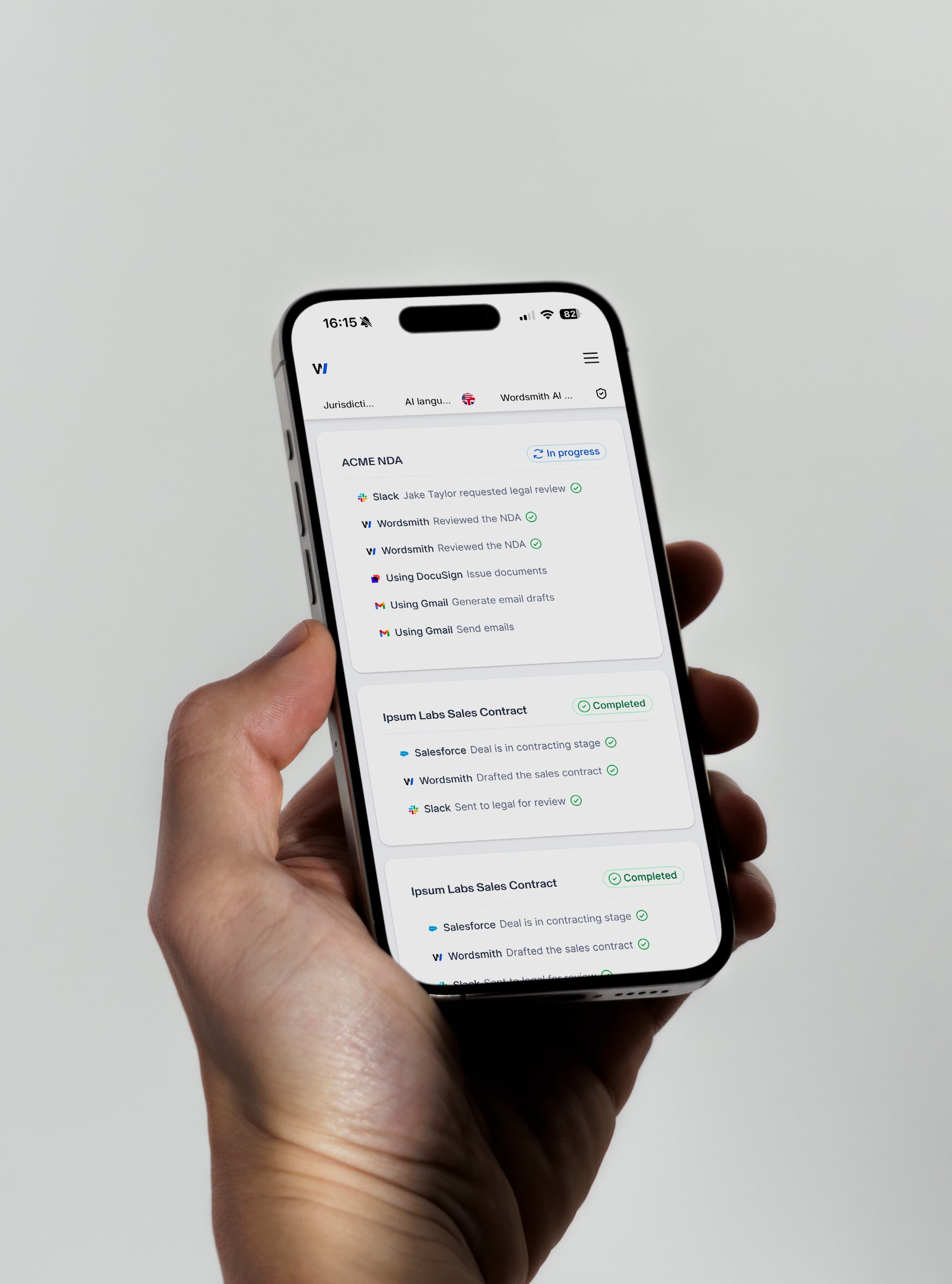
A platform manages the full request-to-resolution workflow: receiving work from the business, routing it to the right owner, resolving routine matters against your playbooks, and recording every outcome. A point solution optimizes a single task, like contract signing, e-billing, or document review.
Both categories have a place. The distinction matters because the gaps between point solutions are where work disappears. When no single system tracks a request from the moment it arrives to the moment it's closed, you get shadow legal: the business making its own legal calls without legal in the loop. As AI accelerates every other function, that blind spot grows faster than your team can catch it.
The average corporate in-house legal team in the Fortune 1000 uses between four and seven distinct legal technology applications, yet integration gaps and data fragmentation remain persistent challenges (Dataintelo). More tools don't automatically mean better operations. Sometimes they just mean more places for work to hide.
When point solutions make sense
If your team faces one specific, well-defined pain point, a point solution can deliver fast value. A standalone CLM tool works well when contract lifecycle management is the bottleneck and you have no immediate plans to scale your operations tooling. E-billing platforms shine when outside counsel spend tracking is your primary gap. The key condition: you're solving a single problem and you're comfortable managing the rest of your workflow manually or across other tools for now.
When a platform is the better fit
Once your pain extends beyond one workflow, a platform starts earning its keep. Teams that need shared intake, clear ownership across matters, playbook enforcement, and cross-functional reporting belong in a platform. This is especially true if your GC or Head of Legal Ops needs to report what the function actually handled, what it cost, and what stayed in-house. If you're evaluating build vs. buy for legal AI, the platform question often surfaces alongside it.
What should in-house teams evaluate in legal ops software?
Coverage of the request-to-resolution workflow
The first question is straightforward: does this tool handle receive, route, resolve, and record, or only part of that chain? Many products market themselves as "legal operations software" while covering just one or two steps. A contract review tool, for instance, handles resolution but not intake or routing. An intake form handles the receive step but offers no resolution engine.
When evaluating platforms, map each vendor's capabilities against all four stages. Gaps in coverage are gaps in visibility, and gaps in visibility are where risk accumulates. For teams looking at legal ops platform capabilities, the question isn't just what the tool does today but whether it covers the full lifecycle of a legal request.
Reporting and visibility for leadership
Legal has historically been a black box to the CFO. The function does critical work, but it struggles to quantify what it resolved, what that cost, and what would have gone to outside counsel without intervention. Outside counsel spend accounts for an average of 87% of an in-house legal team's total external budget, and 42% of legal departments have received active cost-cutting mandates (ACC).
Any software you buy should give legal a defensible number. That means automated reporting on resolution volume, time-to-close, in-house vs. external counsel split, and cost per matter. If the tool can't produce a report your CFO would accept, it's solving the wrong problem.
Built for in-house, not law firms
This distinction is easy to overlook and expensive to ignore. Law firms bill by the hour. In-house teams are measured on speed, spend reduction, and business enablement. Software designed around billable-hour optimization creates misaligned incentives when dropped into an in-house environment. Look for tools whose core design assumptions match yours: faster resolution, lower outside counsel spend, and more work kept in-house.
59% of in-house legal respondents say they are increasing their use of technology tools, and 88% report stable or increasing tech budgets (Bloomberg Law). The budget is there. The question is whether it goes to tools aligned with in-house priorities.
How do leading platforms compare in 2026?
When comparing legal ops platforms, evaluate along four dimensions: function-wide management vs. individual productivity, intake and triage capabilities, playbook automation, and measurable outcomes.
Some platforms focus on making a single lawyer faster, essentially acting as a personal productivity tool. Others manage legal as a function: shared intake so every request is seen, clear ownership so nothing falls through, playbook enforcement so routine matters resolve consistently, and a record of who decided what and why. The difference matters because a personal productivity tool gives you a faster individual. A function-level system gives a GC oversight of everything the team handles.
The number of in-house counsel in the United States has grown 87% since 2008, reaching 145,000 in 2024 (ACC). Teams are bigger, workloads are heavier, and the coordination problem demands a system, not a collection of individual tools.
More than 500 in-house teams run on Wordsmith, including BT, Canva, Financial Times, Safelite, Revolut, Sage, and Starling. At Belron, a Wordsmith customer, external counsel savings reached over $100k in four weeks, daily usage covered 94% of the team, and time saved per task measured 238 minutes.
Only 37% of legal departments expect an increase in outside counsel spend in 2026, and only 32% expect attorney headcount increases (CLOC and Harbor). The implication is clear: teams need to do more with what they have. That tilts the evaluation toward platforms that manage the whole function rather than tools that speed up one part of it. For teams in regulated industries, a sector-specific buying guide can help sharpen the criteria.
Frequently asked questions
Do I need to replace all my point solutions to adopt a platform?
No. Most platforms integrate with existing tools like Slack, Microsoft Teams, and standalone CLM or e-billing systems. The goal is a single system of record that connects your existing stack, not a mandate to rip out every vendor. Look for platforms with native integrations and open APIs so your current investments keep working.
How do I measure ROI on legal ops software?
Track three things: external counsel savings (matters resolved in-house that would have gone outside), time saved per request (from intake to resolution), and adoption rate across the team. A tool nobody uses delivers no ROI regardless of its feature set. If a platform can show you these numbers in its own reporting, you have a built-in business case for renewal.
Can a platform still keep judgment with the lawyers?
Yes, and it should. Routine work runs against your team's playbooks, resolving standard questions and low-risk matters without pulling in a lawyer. Complex or high-stakes matters escalate to the right person, with every step recorded. The result is that lawyers spend their time on judgment calls, not on answering the same question for the twentieth time.
What if my team is too small for a platform?
Team size matters less than workflow complexity. A small legal team fielding requests from a large employee base has a coordination problem that a platform solves better than a point solution. If work comes in from multiple channels and you can't report on what your team handled last quarter, you're a platform candidate regardless of headcount.
The decision comes down to what you're managing
If you need to solve one specific problem and nothing else, a point solution will do the job. If you need to manage legal as a function, with shared intake, consistent resolution, and reporting that gives leadership real numbers, you need a platform.
The rest of the business already has AI and is not waiting for legal to catch up. Every quarter you spend without a system of record is another quarter of scattered work, invisible outcomes, and outside counsel spend that could have stayed in-house. The buying decision is not just about software. It's about whether legal operates as a measurable function or remains the one team nobody can put a number on.