
PRODUCT
Wordsmith for Payments: Three AI Agents Built for the Work.
The networks, your bank, and your regulator all set rules you have to maintain. Here is how a lean payments team keeps every one.

Sam RubackLegal Engineering Lead

BOOK A DEMO
See how the world's leading legal teams are building the future of in-house legal.
PRODUCT
The networks, your bank, and your regulator all set rules you have to maintain. Here is how a lean payments team keeps every one.

Lawyers live in Word. Wordsmith works there too. Review, redline, draft, research, and translate without ever leaving the document in front of you.

Global legal intelligence built around your business, hundreds of trusted sources across 130+ jurisdictions, combined with deep knowledge of your entities, risk profile, and prior positions.
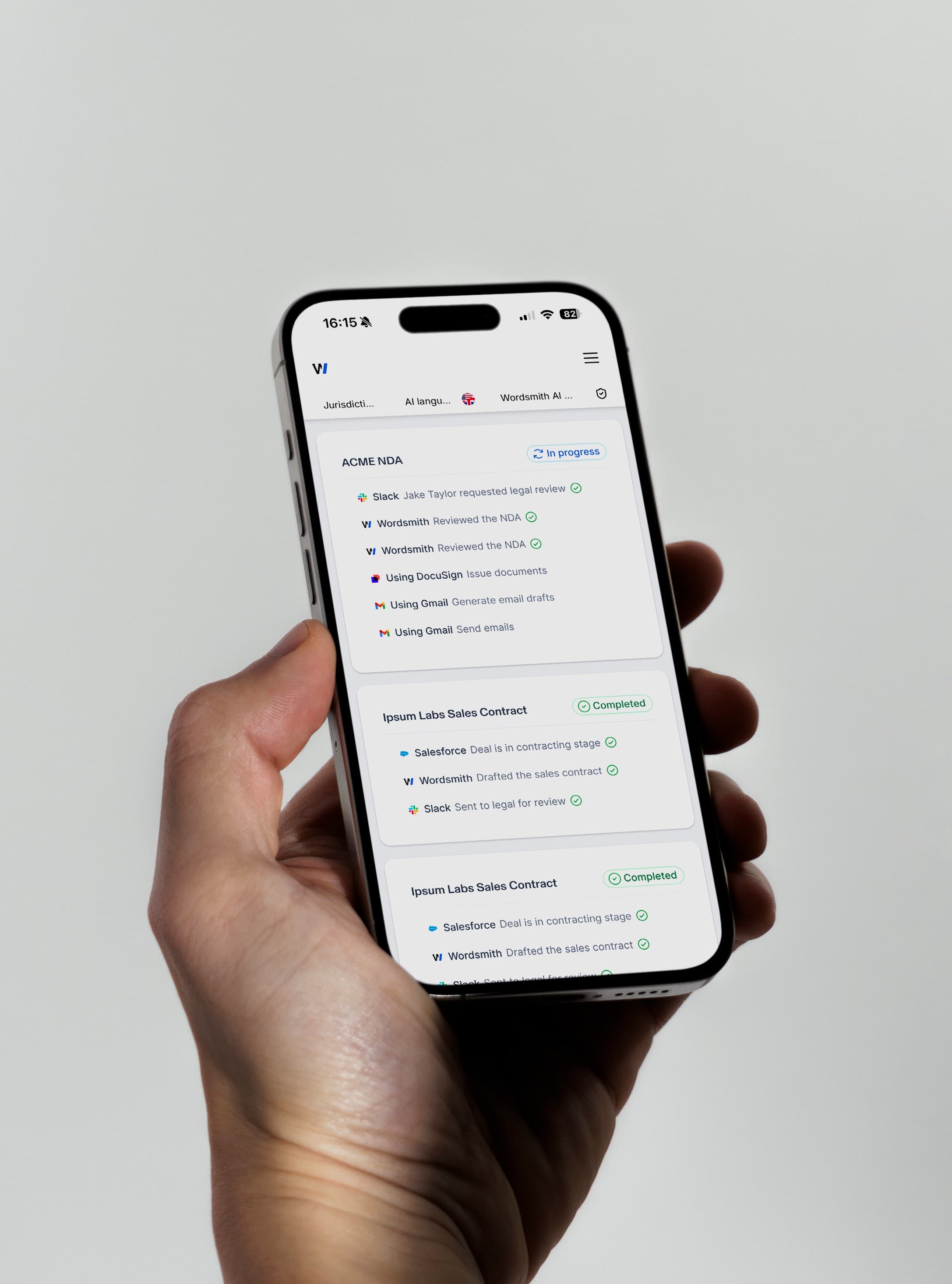
Chain drafting into a full end-to-end workflow. Receive the request, draft the document, route for approval, and send. No manual step required.
Run legal at a payments business and most of your time goes on keeping rules you didn't write.
The card networks set what has to be in your merchant contracts. Your sponsor bank passes down the obligations it owes its own regulator, then asks you to prove you're meeting them on demand. The regulator watches both. You do it with a team a fraction of the size of the bank whose licence you sit on, holding the risk for every merchant and partner beneath you in the chain.
None of it fails loudly. A clause drops out of a redline and nobody notices for a year. An attestation goes stale between quarters. A scheme bulletin lands, looks irrelevant, and turns out to matter. You find out when the fine arrives.
Three agents take this work off your plate. Each one reads, checks, and drafts. You still sign off.
Every merchant agreement has to carry the clauses Visa and Mastercard mandate: PCI compliance, chargeback liability, scheme-fine pass-through. Drop one in a negotiation and it's you, not the merchant, who pays.
That's getting more expensive. Visa's Acquirer Monitoring Program (VAMP) has been enforced since October 2025, and on 1 April 2026 the ratio that flags a merchant as "excessive" tightened from 2.20% to 1.50% across the US, EU, and most other regions.
The agent reads each contract against your playbook and scores every clause: accept, push back, or serious problem. Then it does the part people skim past. It checks that each mandatory clause is actually there, matched to the rule itself rather than re-judged from scratch each time. A clause can't be quietly dropped, because catching it was never left to chance.
Back comes a marked-up contract, your VAMP exposure, and a one-page note on what to hold and what to concede. Then you negotiate.
Your sponsor bank isn't a silent partner. It owes the regulator, so it hands those duties to you in the contract: safeguarding, AML, resilience, audit rights, incident deadlines. It expects proof, whenever it asks, that you're keeping each one. Those obligations sit buried across long agreements that keep changing, and after the Synapse collapse, banks stopped being patient about evidence.
The agent reads every agreement and turns it into one live list: each obligation, who owns it, the evidence that proves it, and the date that evidence expires. It drafts the attestations the bank wants and refreshes the whole thing every quarter.
So the next time the bank asks how you meet a duty, the answer is already written.
Visa and Mastercard change their rules constantly. Most of any bulletin has nothing to do with you, which is exactly why the part that does is so easy to miss.
The agent reads all of them and keeps only what applies to you. For each change, it drafts the policy update, the contract wording, and the merchant notice, every one tied to the rule and its effective date.
Instead of a stack of unread PDFs, you get a short list of what to do, and a record that every change was handled on time. That record is the first thing a diligence team or an auditor asks for.
Every agent runs on your rules, your red lines, and your sign-off. Each step is logged, and nothing goes out until a person says so.
You already do this work. The agents just make sure nothing slips while you're busy with everything else.
Pick the one that worries you most. Add the next once it earns your trust.
If you run legal or compliance for a payments business inside the card networks, whether you process payments for merchants, run a payment-facilitation model, or manage a card program, Talk to the team, or join the Legal Engineering Project to learn more and build alongside other practitioners.