PRODUCT
Introducing Usage & Value: Put a number on what legal AI delivers
Measure what legal AI is actually delivering, from the work being done to the time, capacity and economic value it represents.
From AI adoption to AI accountability
Enterprise AI has moved into a different phase. The first question was whether people would use AI and where it could fit into day-to-day work. Leaders now want to know what the investment returned and how to explain that value in a room where someone will challenge the number.
Legal is a particularly useful place to ask that question because the work already has established economics around it. Lawyer time, team capacity, outside counsel rates and external spend all give Legal reference points for understanding what AI is changing. As AI becomes part of how legal work gets done, the conversation naturally shifts from adoption towards impact.
Why adoption metrics only tell part of the story
Seats, logins, sessions and prompts are useful signals of adoption. They can show whether people are engaging with the technology and where usage is growing, but they tell you far less about the substance of the work being done.
A thousand prompts could represent a meaningful amount of contract review, research and drafting, or they could represent something much lighter. For legal leaders, the more important question is what all of that activity actually delivered and what it means for the team. That is where usage data becomes much more useful when it connects to the work underneath it.
Why measuring AI value gets difficult quickly
The move from usage to value sounds simple, but the calculation becomes more complex very quickly. Time saved creates capacity. Work handled internally can change the team’s reliance on outside counsel. Greater coverage can help Legal support more of the business and absorb additional demand.
Each of those outcomes has a different economic meaning, which makes the assumptions behind a value estimate just as important as the final number. A credible approach needs to show what work was done, how the estimate was reached and which inputs come from the business itself.
Introducing Usage & Value
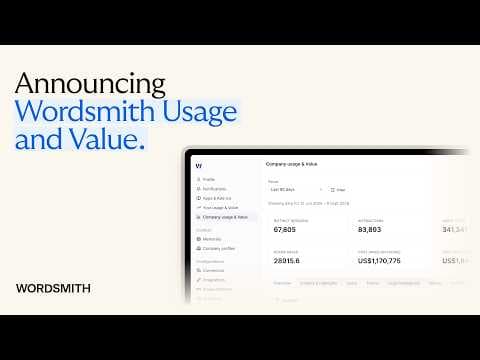
Today, we’re launching Usage & Value, which helps legal teams understand what their AI investment is delivering. It connects the legal work being done in Wordsmith to estimated time, cost and capacity, including what that same work represents at outside counsel rates. Customers control the rates and assumptions behind the calculation, with a clear view of how each estimate was reached.
Legal teams can track usage across teams, people, Agents, Skills and Playbooks, then break that activity down by work type, document, language and jurisdiction. From there, they can understand what the work represents in estimated time, in-house value and outside counsel equivalent value. Our view is that AI value should be measured from the work it actually helps complete.
Put a number behind the work
The goal is to give Legal a value figure it can explain with confidence. When leadership asks what the AI investment delivered, the team can show the work behind the number, the capacity it represents and the assumptions used to calculate its value.
For Legal Operations, the same data helps answer what comes next. It can show which teams are creating the most capacity, which workflows are producing the most value, where adoption could go further and where AI is changing the balance between work handled internally and work sent outside. Usage becomes more than a reporting layer. It becomes an input into how the legal function is run and where the team chooses to invest next.
The next phase of legal AI
Legal AI has spent its first phase proving capability across research, drafting, review, Agents and workflows. The next phase will increasingly be about proving what those capabilities deliver for the business.
That means giving legal teams a clearer view of the work being done, the capacity being created and the economics behind it. It also means making the assumptions visible enough that Legal can take the number into a conversation with Finance or leadership and explain where it came from.
Usage & Value gives Legal the work, the capacity and the economics behind the number.