Financial services legal and compliance teams are stretched: there is always more work to do than there are qualified people to do it.
The work is already defined: KYC files to be checked, ICT contracts to meet DORA, final agreements to match the commercial terms that were approved, and the list goes on. It is high-volume, high-stakes, and too repetitive for senior lawyers to handle line by line.
This is where Wordsmith Agents are already being used by our customers within financial services today.
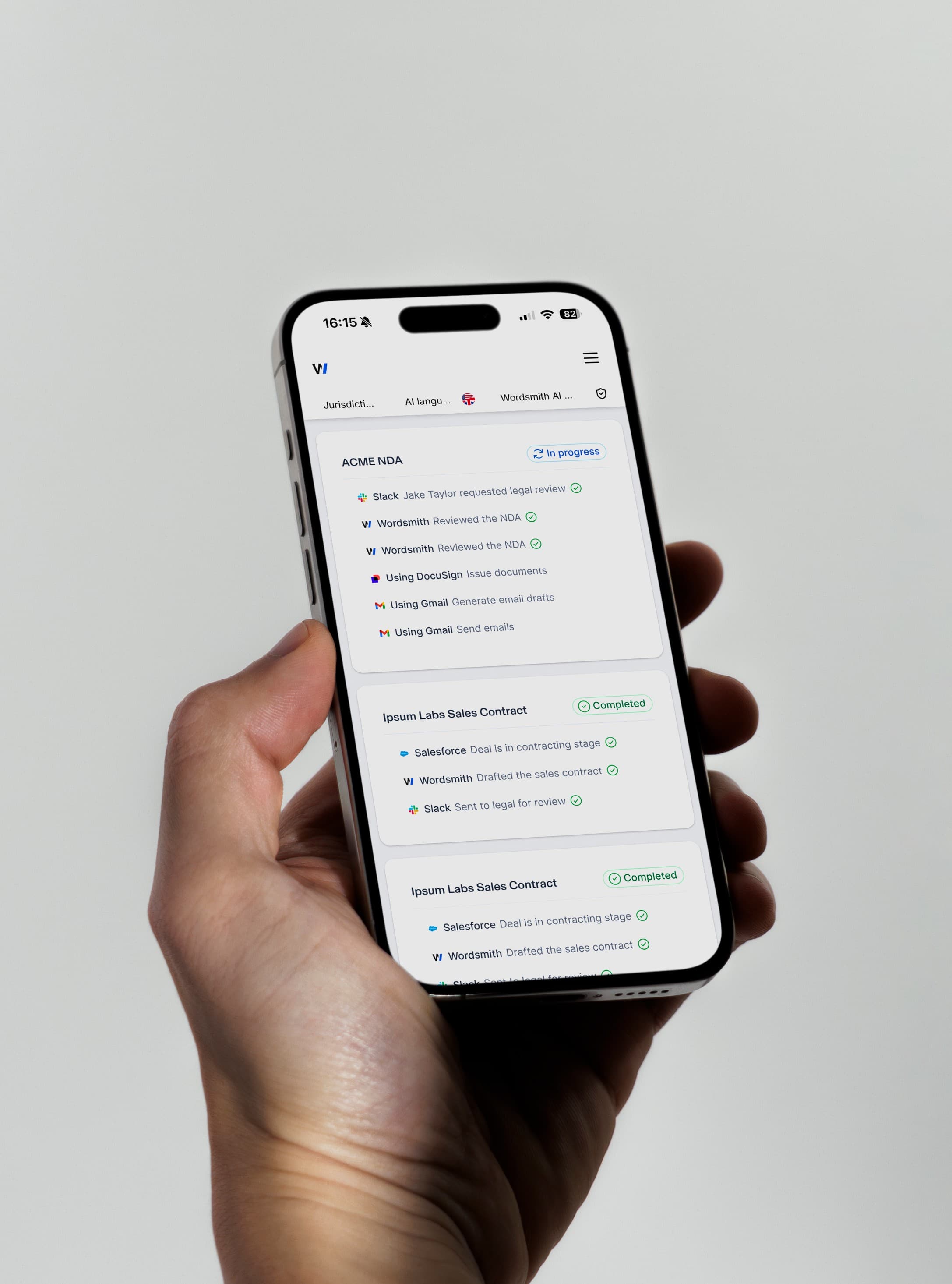
An Agent is the most capable system Wordsmith has built. It works as an orchestrator: rather than a single prompt, it runs the Skills, Playbooks, Reports, Blueprints and Repositories you have already built as one process, end to end. It handles intake through email, Teams, or Slack, reads the documents, works through the steps in order, and routes the finished output to a person for approval.
Every step is logged, legal can see what each Agent has done at any point, and teams set the permissions that keep them in control.
Here are three of the highest-impact Agents we see in financial services.
1. KYC reconciliation, completed on arrival.
KYC (Know Your Customer) entity onboarding stalls for a simple reason: nobody knows a pack is incomplete until someone reviews it by hand, and by then days have passed.
A Wordsmith Agent removes that wait. The moment a pack lands, it reads the entity type and picks the applicable checklist. It then runs a Skill that reconciles every document against that checklist.
It also checks your Repository of prior KYC evidence, reusing anything already on file rather than requesting it again.
What comes back is a clear table: every item present, missing, or inconsistent, each tied to its source. Where something is missing, it drafts the client email for exactly what is needed, so remediation starts the same day.
The Agent stays deliberately scoped: every check is logged, the team sets what it can do, and the judgment stays with them under the relevant money laundering regulations.
2. DORA contract review, across the whole vendor estate.
DORA (the Digital Operational Resilience Act) created a problem of scale. Firms may have hundreds or thousands of ICT vendor contracts to review, with gaps to find and repapering to track. By hand, that is slow, inconsistent, and hard to defend.
A Wordsmith Agent makes the whole estate reviewable at once. It runs a Report keyed to DORA, with each article set as a test, returns a status for every provision, and cites the language it relied on. A multi-month exercise becomes a single pass you can rerun whenever the book changes.
It then prioritizes by criticality, renewal date, and exposure, so legal sees what to fix first.
Remediation does not stop there. Where terms are missing, the Agent runs a drafting Skill to prepare an addendum covering only the required changes, or a counterparty notice where an addendum is premature.
Every draft is logged, and the outcome is an owner-ready view of DORA compliance, grounded in Articles 28 and 30, with evidence attached.
3. Gap analysis, before signing.
Some of the most expensive legal errors are quiet changes between the source document and the final agreement. A rate moves, a termination right disappears, or a point agreed in the term sheet never makes it into the long-form document.
A Wordsmith Agent catches these before signing. It treats the source as the approved position, whether a term sheet, trade recap, or heads of terms.
It then runs a Skill that maps every term, date, and condition, and compares it line for line against the draft. What comes back is a discrepancy table, marking each item as a match, mismatch, missing term, or extra provision, with citations in both.
Where the fix is clear, a redline is proposed from a Blueprint for the lawyer to approve. Every change is logged, so the lawyer stays in control. The same pattern works across loan agreements, confirmations, SPAs, leases, and employment contracts.
Build your own Agents
These are three examples among many. An Agent works as the orchestrator: you give it an intake channel and the documents to work from, then assemble the blocks it runs. Playbooks hold your review rules, Reports handle structured extraction, Repositories give live document search, and Skills chain them into a repeatable method.
You decide where a person approves and what the Agent can do on its own. You configure it once, and it runs the process from then on.
Want to build your own Agents? Talk to the team, or join the Legal Engineering Project and build alongside other practitioners.