ARTICLE
The standard is the work: three legal Agents for financial services.
Learn how AI Agents apply your team's agreed standards and precedents to accelerate reviews of facility agreements, LPA consents, and marketing campaigns.


BOOK A DEMO
See how the world's leading legal teams are building the future of in-house legal.
ARTICLE
Learn how AI Agents apply your team's agreed standards and precedents to accelerate reviews of facility agreements, LPA consents, and marketing campaigns.


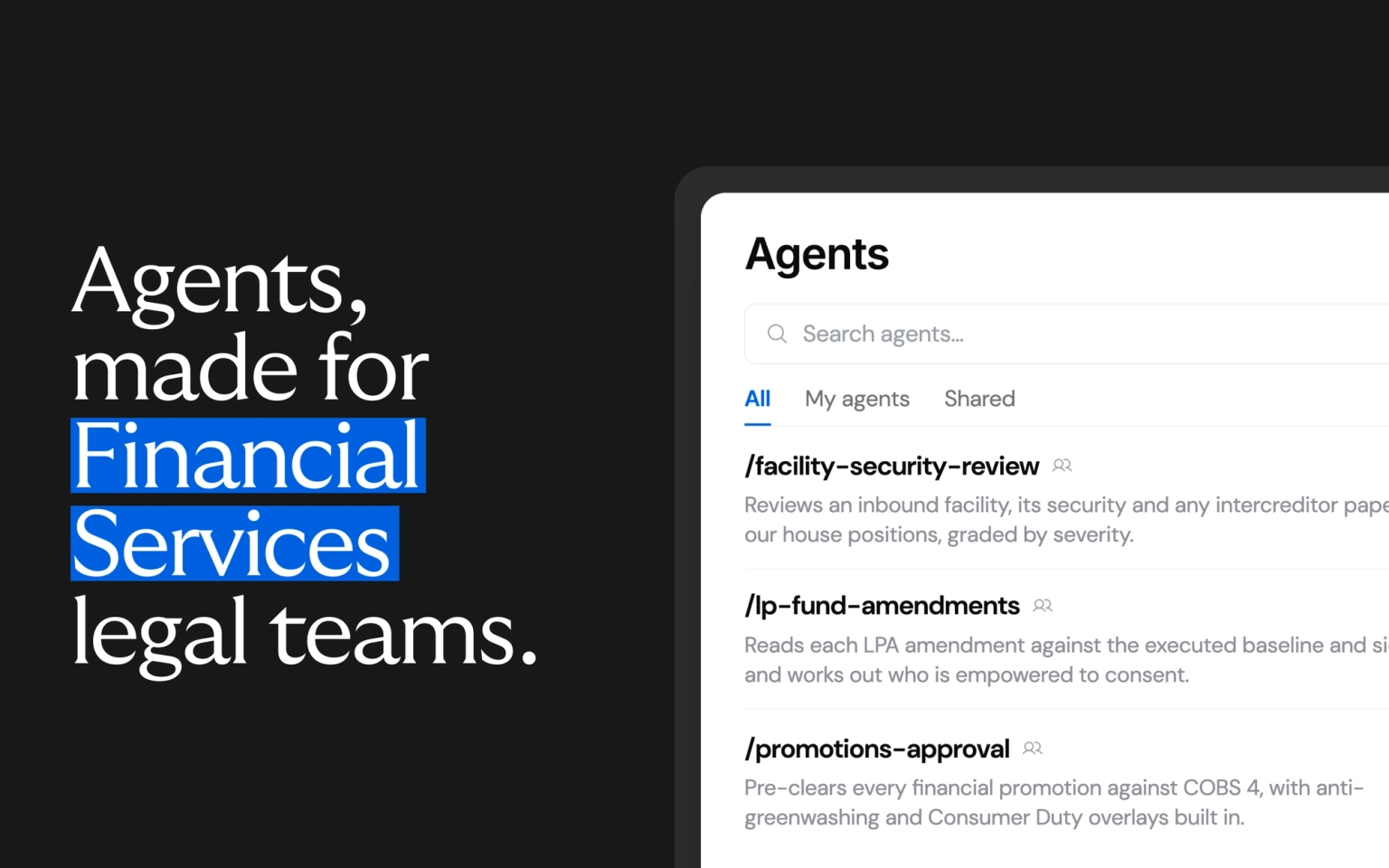
When a matter lands with legal, the document is rarely the whole story. Behind it sits the team's standard: its agreed positions, precedents, and approval routes.
A Wordsmith Agent brings that standard into the review. Its Repository holds the team's material, while its Playbook explains how to apply it and when to escalate. The Agent does the first pass and shows its work. It is most useful where reviews recur and the same questions return in slightly different forms.
A lender may receive a facility agreement on the borrower's paper, together with security documents and an intercreditor agreement. The drafting may feel familiar, but that only gets the reviewer so far. LMA forms are common in EMEA; LSTA documentation is widely used in the United States, and APLMA forms serve Asia-Pacific markets. Whatever the regional form, the wording may still be wrong for a particular lender or credit.
The Agent's Repository holds position papers, precedents, and credit and security policies. Its Playbook records how the lender treats conditions precedent, financial covenants, events of default, sanctions wording, and the security package, along with accepted fallbacks.
Reading the documents as one pack helps the lawyer see the full picture. The Agent shows what changed, why it matters, which source supports the point, and what fallback is available. This matters as similar reviews move through the team week after week. The lawyer still decides whether the redline is ready to leave the building.
Some risks sit outside the wording. Particulars of a registrable charge must reach Companies House within 21 days of creation. If the deadline is missed, the charge is void against a liquidator, administrator, and creditors of the company. To the extent the lender relies on that charge, it ranks as unsecured.
A GP's LPA amendment or consent request can look like a question of acceptability. Before considering the merits, the investor needs to establish who can approve the change and what threshold applies.
That answer comes from the operative amendment clause. Depending on the provision, consent may require a simple majority, a super-majority such as two-thirds or 75%, unanimity, or the approval of affected LPs. Protected matters may include economics, fund term, GP removal, or liability. ILPA guidance can inform the investor's position, but it does not replace the binding terms of the LPA.
The Repository therefore needs the LPA as amended, the investor's side letter, and every earlier consent. If something is missing, the Agent says so and stops. The Playbook applies the investor's governance standards and delegated authorities, and the Agent extracts the applicable threshold for each change. The lawyer can see what moved, its effect, who must consent, the deadline, and any side-letter or MFN interaction.
Amendment and consent exercises recur across a fund portfolio, making a consistent method valuable. The Agent assembles fees, expenses, and waterfall terms; the investor decides.
The words in a financial promotion cannot be separated from the people who will read them. COBS 4 requires a communication to be fair, clear, and not misleading, but wording that works for a professional client may be unsuitable in a retail campaign.
The Repository gives the Agent the firm's marketing policy, risk warnings, approved examples, and FCA guidance. The Playbook explains how the firm balances benefits and risks, how prominent a warning should be, what evidence a claim needs, and whether the audience fits the channel.
Promotions arrive as a continuing flow of work. Each issue returns with a reason and proposed edit. The Agent creates the record required by COBS 4.11 and preserves the review's reasoning. A year later, the final copy is usually easy to find; the reasoning may be much harder to recover.
Some rules send the promotion directly to a named person. An unauthorized person that communicates a financial promotion in breach of section 21 of FSMA commits a criminal offense. Since February 7, 2024, an authorized firm approving a promotion for an unauthorized person has generally needed specific FCA permission, subject to certain exemptions. Wordsmith does not approve the promotion. The sign-off records who did and when.
A good first workflow is one the team knows well. Gather the material that defines its position, write down the method, and identify the decisions that need human judgment.
The honest test is a live document. Talk to the team, and we will put one of these to work on a facility agreement on someone else's paper, an LPA consent request, or a promotion waiting for sign-off.
And if you would rather learn how these are built, or build one yourself alongside other practitioners, join the Legal Engineering Project, our Slack community for legal engineering, created by Elly Meenan, one of our founding legal engineers.

Lawyers live in Word. Wordsmith works there too. Review, redline, draft, research, and translate without ever leaving the document in front of you.

Global legal intelligence built around your business, hundreds of trusted sources across 130+ jurisdictions, combined with deep knowledge of your entities, risk profile, and prior positions.

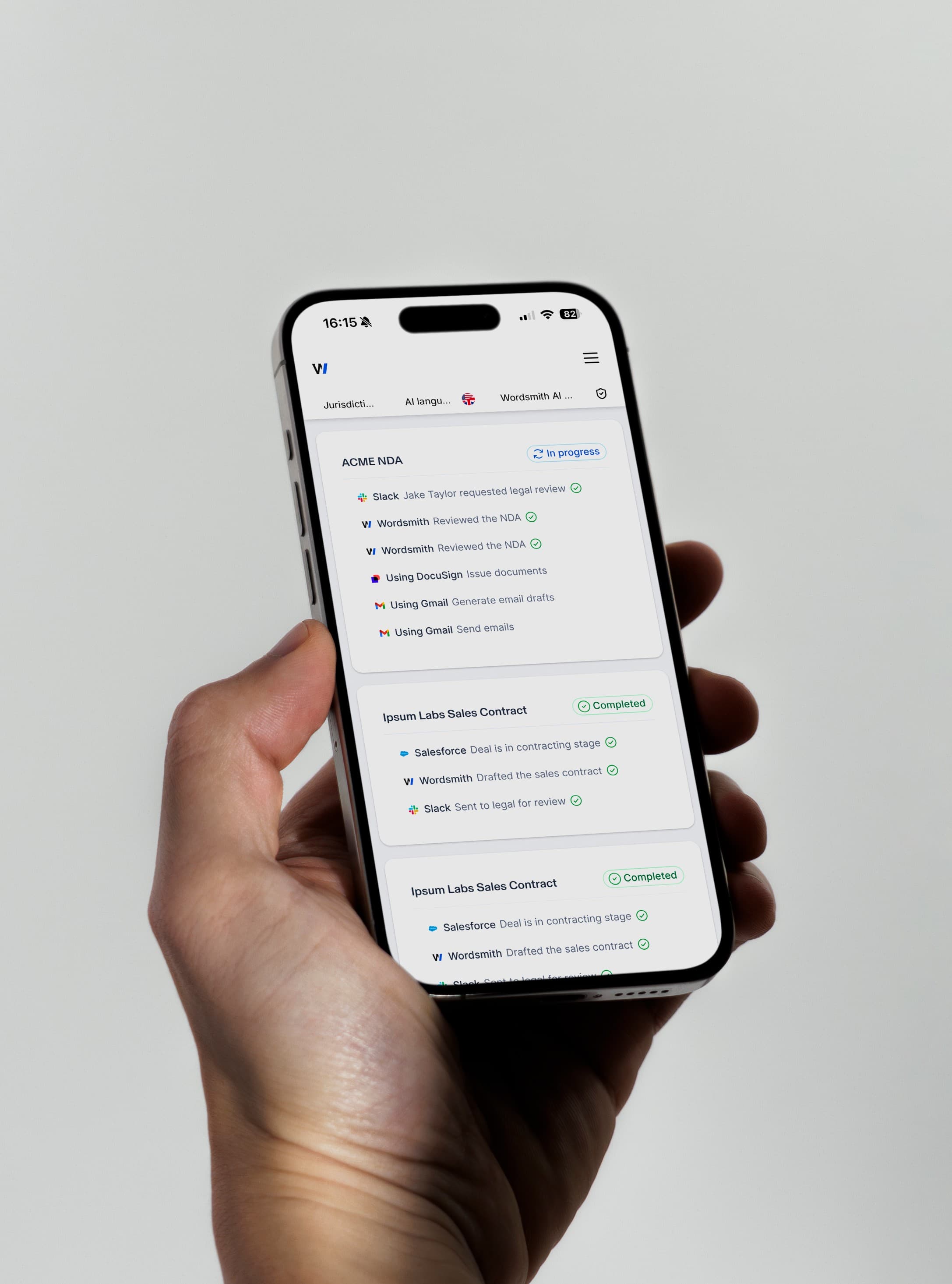
Chain drafting into a full end-to-end workflow. Receive the request, draft the document, route for approval, and send. No manual step required.