.
Article
Legal & HR
Introducing the intelligence layer for modern People teams. Equip your HR and Talent teams with the legal intelligence to hire globally, standardize agreements, and answer employee queries instantly - all while maintaining the highest compliance standards.

The Vision: High-Velocity, High-Compliance
In a fast-moving business, the People function needs to be an enabler, not just an administrator. Wordsmith bridges the gap between Legal and HR, giving your team the tools to operate with autonomy, precision, and strategic insight across every jurisdiction you operate in.
For decades, organizations have faced a trade-off: you could either empower your People team to move at the speed of the market (hiring, onboarding, and restructuring rapidly), or you could lock everything down to ensure 100% legal compliance.
But the most advanced organizations have stopped making this trade-off. By unifying their Legal and HR functions through a shared intelligence layer, they are achieving High-Velocity Compliance.
Here is how Wordsmith enables this collaboration, turning your employment documents from an administrative burden into a strategic asset.
1. Intelligent Blueprints: The Global Hiring Engine
In the race for talent, friction kills deals. If you find the perfect Engineer in Berlin or a VP of Sales in California, you cannot afford to wait a week for external counsel to draft a compliant offer.
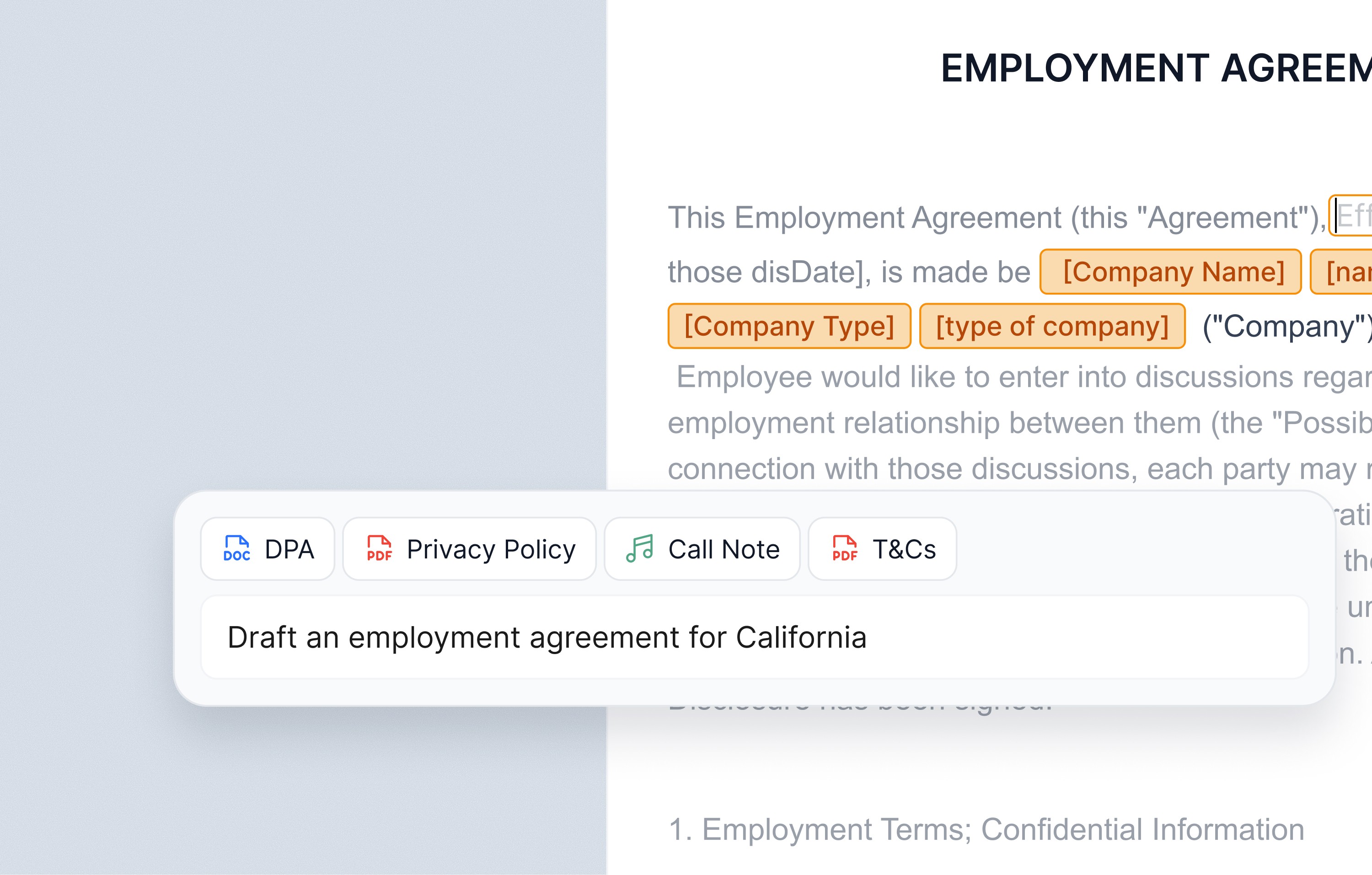
Wordsmith replaces static templates with Intelligent Employment Blueprints. These are drafting engines that have received the seal of approval from your Legal team, allowing HR to self-serve complex documents instantly within safe guardrails.
Context-Aware Logic: The system understands that employment law changes when you cross a border.
Hiring in the UK? The Blueprint automatically inserts statutory notice periods and pension clauses.
Hiring in California? It instantly strips out non-compete clauses and updates IP assignment language to match state regulations.
Hiring in Germany? It ensures the contract adheres to strict written form requirements.
Role-Based Adaptation: This is where compliance meets strategy. Legal sets the rules once—for example, Senior VPs get 6 months' severance; Juniors get 1 month. When a Talent Partner generates an offer, the Blueprint automatically adjusts the restrictive covenants, bonus structure, and notice periods based on the seniority level selected.
The Value: Your People team can hire in any jurisdiction, at any level, with the confidence that every contract is fully aligned with Legal's internal requirements.
2. Project Clean House: Turning Contracts into Commercial Assets
As companies scale from Series B to C, or prepare for an exit, the state of their employment repository becomes a critical commercial factor. Investors don't just ask who works for you; they ask what terms they are on.
Manually auditing 500+ PDF contracts to check for IP assignments or non-compete clauses triggers is a massive drain on resources. Wordsmith transforms this due diligence panic into a state of perpetual readiness.
Bulk Analysis & Insight: You can upload your entire repository of executed agreements into Wordsmith. The AI extracts the data that matters—Notice Periods, Probation Clauses, Bonus Types—into a structured report.
Visual Intelligence: Data is easier to action when you can see it. Wordsmith can generate org charts, process diagrams, and flowcharts directly in the chat to visualize your workforce structure or approval flows.
The Golden Source Comparison: The system compares your actual signed contracts against your ideal standard terms. It instantly visualizes the gap: Identify all employees whose notice period does not match their current seniority level.
Automated Remediation: Wordsmith closes the loop. It can redline the necessary amendments for those non-compliant contracts and draft the personalized notification emails to employees.
The Value: You move from data blindness to having a pristine, due-diligence-ready data room at all times.
3. The Employee Experience Engine: Delight at Scale
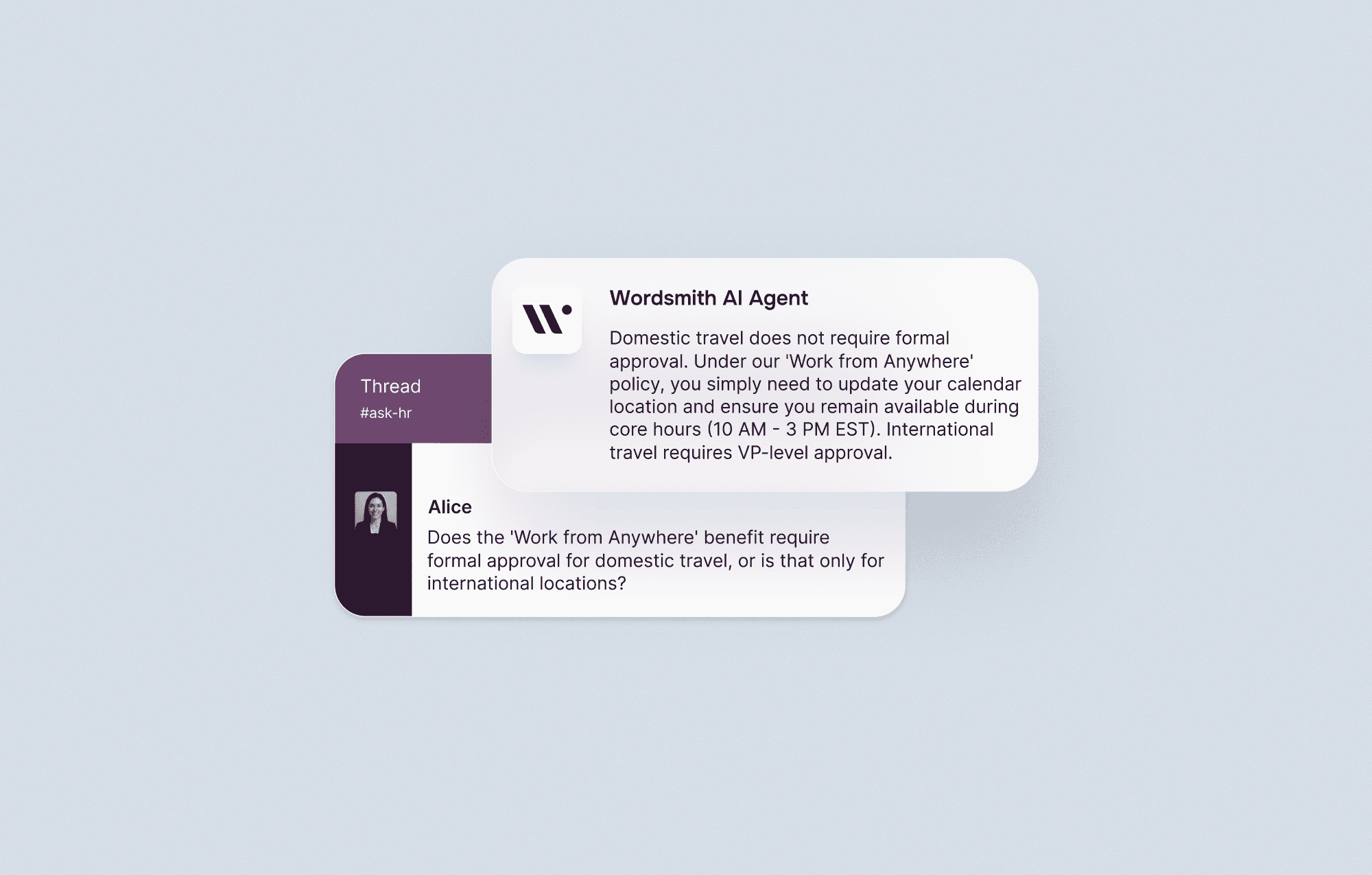
The dependency loop doesn't just exist between HR and Legal; it exists between Employees and HR. People teams are often buried under mountains of repetitive questions, preventing them from doing strategic work.
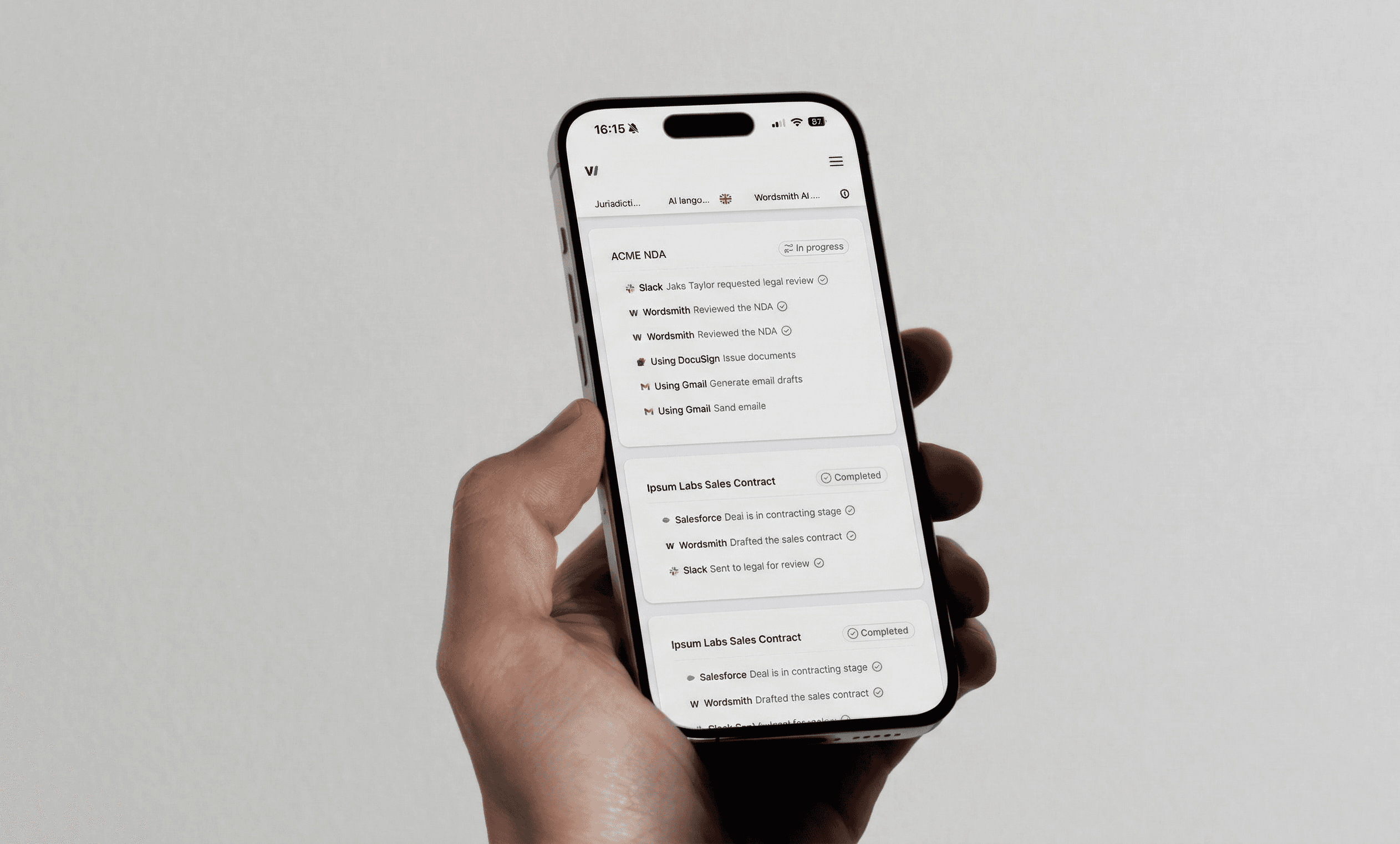
Wordsmith integrates directly into Slack, Zendesk, Email, MCP, or Zapier to serve as an always-on People Partner, delivering a consumer-grade experience to your workforce.
Instant Resolutions: Employees get immediate answers to queries on PTO, benefits, and 401(k) matching—sourced directly from your Handbooks.
Private & Secure: Employees love the ability to ask sensitive questions privately via the Wordsmith app (Direct Messages), ensuring confidentiality without needing to post in public channels.
Consistent Messaging: Ensure every employee receives the exact same policy information, eliminating confusion and verbal contract risks.
Source Transparency: Answers are always linked to the source document (e.g., Referencing 2025 US Employee Handbook, pg 12), building trust and transparency across the organization.
The Value: HR escapes the support ticket treadmill, and employees get the instant, private answers they expect.
4. Digitizing Culture: Process Consistency as a Service
Culture isn't just about values; it's about how you treat people during critical moments, whether that’s a performance review or a restructuring.
Inconsistent processes create legal risk (e.g., unfair dismissal claims) and cultural damage. Wordsmith allows you to digitize your internal playbooks.
From Document to Workflow: You can upload your organization’s unique scripts, such as your Redundancy Consultation Script or Performance Improvement Plan (PIP). Wordsmith converts these into smart, interactive workflows.
Guided Execution: When a manager needs to have a difficult conversation, they aren't improvising. They are following a structured, compliant path set by your Legal Team that ensures they say the right things (and avoid the wrong things), ensuring procedural fairness is baked into every interaction.
The Value: You scale your specific culture and operational standards across every manager and department, reducing the risk of human error.
5. Horizon Scanning: The Invisible Shield
The velocity of employment legislation is increasing. From the EU Pay Transparency Directive to new federal salary rules in the US, keeping a Global Handbook up to date is a full-time job.
Wordsmith acts as your Legislative Watchdog.
Proactive Monitoring: The platform monitors legal changes across your key operating markets.
Policy Health Checks: Instead of waiting for an annual review, the system cross-references new legislation against your existing policies and contracts. It alerts you proactively: New legislation in the UK impacts Clause 4 of your Paternity Policy.
The Value: Your compliance posture becomes proactive rather than reactive. You are protected against unforeseen risks.
Explore Legal x HR product functionalities here.
The Value: Why Teams Partner with Wordsmith
By unifying the People and Legal functions on one platform, both teams unlock specific, high-impact benefits.
For the People Team:
Autonomy: Execute complex documents like Separation Agreements and cross-border contracts self-sufficiently, without waiting on legal review for every draft.
Speed: Reduce time-to-hire and manage exits efficiently by removing administrative friction.
Strategic Impact: Bring data-backed insights on workforce liability (e.g., Total Severance Exposure) to the executive table, moving HR from a cost center to a strategic partner.
For the Legal Team:
Scalable Compliance: Define the logic once (the Architect model) and let the business build safely within those guardrails.
Risk Assurance: Ensure every document—from a routine Offer Letter to a sensitive Tribunal claim—starts with a legally sound foundation.
Cost Efficiency: Significantly reduce external counsel spend on routine international templates (e.g., How do we hire in France?) and repetitive contract reviews.
Conclusion: The Architect and The Builder
Ultimately, Wordsmith establishes a new operating model for the relationship between Legal and HR:
Legal acts as the Architect: They define the logic, the risk tolerance, and the templates once.
HR acts as the Builder: They execute, hire, and manage with total autonomy, knowing they are building safely within the Architect's guardrails.
When these two teams share a single platform, the friction disappears. Speed increases. Risk decreases. And the People function is finally free to focus on what matters most: the people.