.
Article
Will AI Replace Paralegals? The In-House Paralegal’s Guide to Thriving in 2026
Worried AI will replace your paralegal job? Discover why AI is an opportunity, not a threat. Learn how to leverage AI tools to automate routine tasks, focus on high-value work, and become an indispensable strategic partner to your in-house legal team.

A 2023 Goldman Sachs report estimated that generative AI could automate up to 44% of legal tasks, a statistic that has understandably caused widespread concern (Thomson Reuters). This isn’t just an abstract number; it reflects a sentiment echoed throughout the legal community. According to the Association of Corporate Counsel (ACC), 89% of legal professionals expect AI to significantly affect their profession in the next five years. But what does this mean for you, the in-house paralegal? It’s the question on everyone’s mind: will AI take my job?
The answer is a clear and definitive no. AI will not replace paralegals. Instead, it will elevate the role, automating the tedious, repetitive tasks that cause burnout and freeing paralegals to become more strategic, tech-savvy partners to their in-house legal teams. This guide will show you how to embrace this transformation and not only survive, but thrive in the AI era.
The Reality of AI in Legal Support: Augmentation, Not Replacement
The fear of replacement stems from a misunderstanding of what AI does well. AI is excellent at performing discrete, repetitive tasks, but it cannot perform a job. A job is a complex collection of tasks that requires uniquely human skills like critical thinking, emotional intelligence, creative problem-solving, and building relationships—skills that are at the core of the paralegal profession.
The reality is that AI will augment the paralegal role, not automate it out of existence. It will act as a powerful assistant, handling the high-volume, low-value work so that you can focus on the high-value, strategic work that truly matters.
Tasks AI Will Automate | Tasks Where Humans Excel |
|---|---|
First-pass document review | Complex legal analysis & strategy |
Data extraction and entry | Client communication & relationship building |
Generating first drafts from templates | Negotiating with opposing counsel |
Summarizing transcripts & depositions | Managing complex projects with multiple stakeholders |
Tracking deadlines & sending reminders | Ethical judgment & decision-making |
The Top 5 AI-Powered Tool Categories Transforming Paralegal Work
Embracing AI begins with understanding the tools that are available today. Here are five categories of AI-powered software that are changing the game for in-house paralegals.
1. AI-Powered Document Review & Analysis
Before AI: Manually reading through hundreds of pages of contracts to find a specific clause or assess risk.
After AI: Using an AI-native platform like Wordsmith to instantly search and analyze thousands of documents, identify key terms, and flag non-standard language in seconds. This transforms due diligence and contract review from a multi-day slog into a focused, analytical task.
2. Intelligent Legal Intake & Triage
Before AI: Spending hours each day monitoring an overflowing legal inbox, manually reading each request, and forwarding it to the correct lawyer.
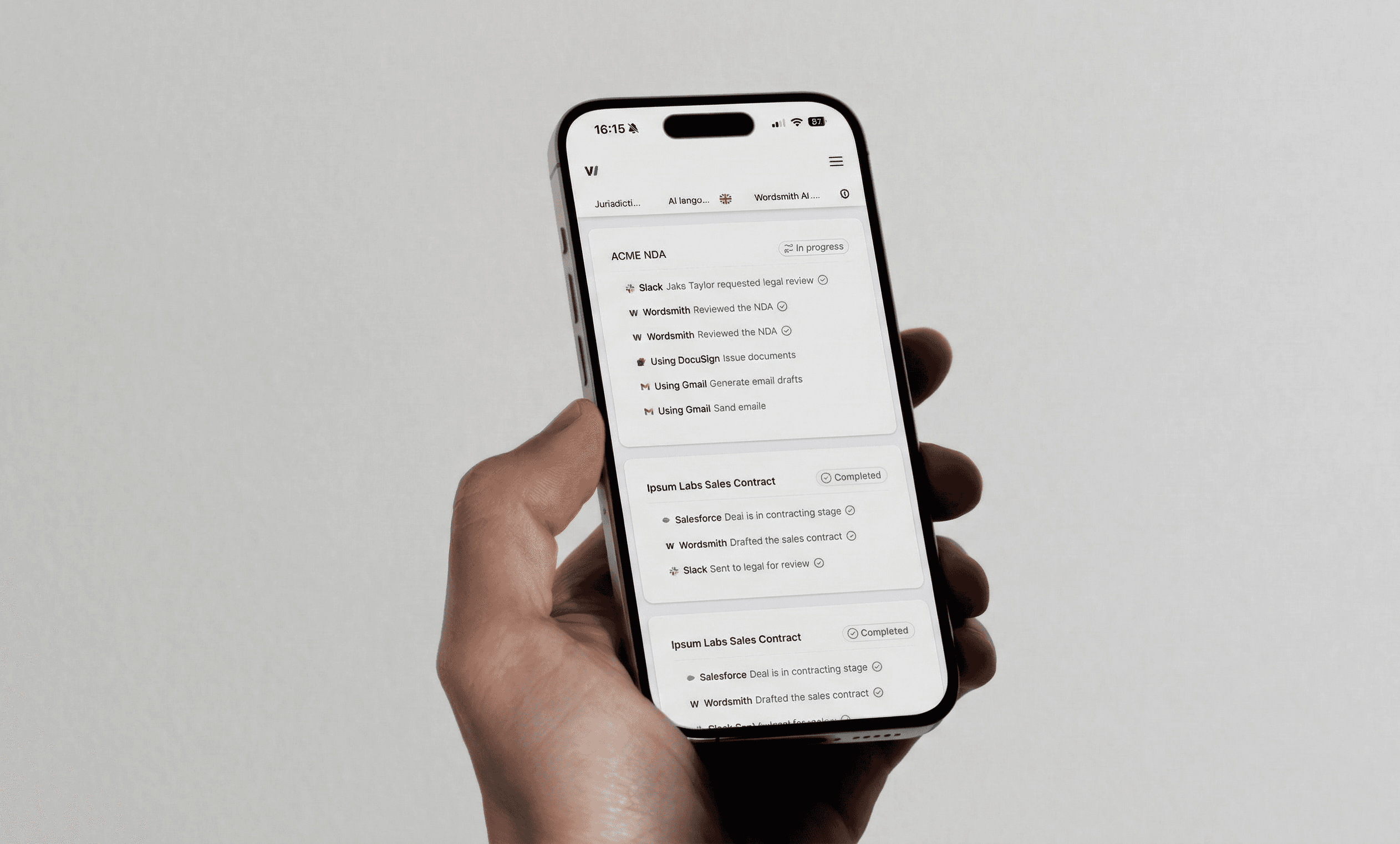
After AI: An intelligent intake platform like Wordsmith automatically categorizes incoming requests from business partners, triages them based on urgency and type, and routes them to the appropriate automated workflow or legal team member, giving you back hours of valuable time.
3. AI-Assisted Drafting
Before AI: Starting every new contract or legal document from a blank template, manually filling in the details, and hoping you haven’t missed anything.
After AI: Using the drafting features within an AI-native hub like Wordsmith to generate a high-quality first draft of a standard agreement in seconds, complete with the correct entity names and key terms, allowing you to focus on refinement and strategy.
4. Automated Legal Research
Before AI: Spending hours navigating complex databases, piecing together case law and statutory interpretation.
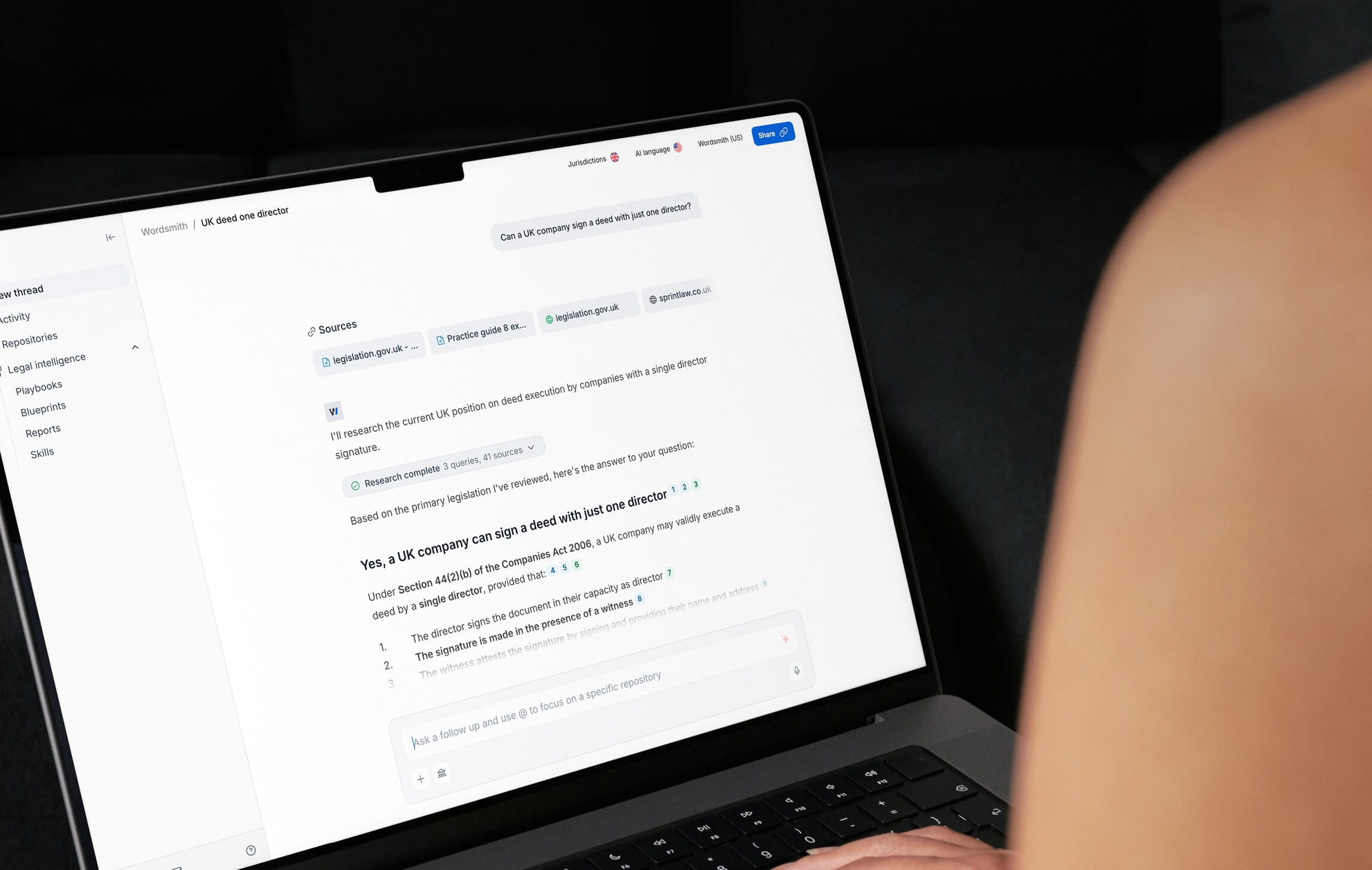
After AI: Using a modern AI research tool to ask a plain-language question and receive a detailed, memo-style answer complete with citations to primary sources, turning hours of research into minutes of validation.
5. Deposition & Transcript Summary Tools
Before AI: Manually reading through hundreds of pages of deposition transcripts to identify key themes, admissions, and timelines.
After AI: Uploading a transcript to a specialized AI tool and receiving a fully summarized document with hyperlinked topic sections, allowing you to quickly grasp the most critical information from hours of testimony.
The Upskilled Paralegal: 3 Essential Skills for the AI Era
Thriving in the age of AI requires a shift in focus from doing the work to managing the systems that do the work. Here are three essential skills every paralegal should develop, as highlighted in reports from legal associations like the American Bar Association.
Become a Prompt Engineering Expert: The most valuable skill in the AI era is knowing how to ask the right questions. Learning how to “talk” to AI—crafting clear, specific, and context-rich prompts—is the key to unlocking its full potential. The paralegal who can get the best outputs from AI will be indispensable.
Master Workflow Design: Instead of manually performing a multi-step process, your value will come from designing the automated workflow that handles it. This involves identifying repetitive tasks, mapping out the process, and using an AI-native platform to build an automated system that runs 24/7.
Develop Data Analysis Skills: Legal departments are becoming more data-driven, and paralegals are perfectly positioned to lead this charge. Use AI to extract and analyze data from contracts, matters, and legal spend, and then present those insights to your GC to inform strategic decisions.
Conclusion
Far from being a threat, AI represents the single greatest opportunity in the history of the paralegal profession. It automates the tedious and elevates the strategic. By embracing AI tools to handle routine work, paralegals can shed their administrative burden and evolve into their true potential: as strategic, tech-savvy, and indispensable partners to the business. The future is not about being replaced by AI; it’s about becoming the human who knows how to leverage it.
Ready to become an AI-powered paralegal? Discover how Wordsmith can automate your routine tasks and free you up for the work that matters.
Frequently Asked Questions (FAQ)
Q1: What paralegal tasks can AI not do?
AI cannot replicate tasks that require deep human judgment, empathy, and complex communication. This includes building relationships with clients and business partners, negotiating with opposing parties, exercising ethical judgment, and providing creative strategic advice.
Q2: Do I need to learn to code to use legal AI?
No. The vast majority of modern legal AI tools are “no-code” or “low-code,” meaning they are designed to be used by legal professionals with no programming background. The key skill is not coding, but understanding legal processes and how to apply the technology.
Q3: How will AI affect paralegal salaries?
In the long run, AI is likely to have a positive impact on the salaries of tech-savvy paralegals. By taking on more strategic, high-value work and demonstrating a clear ROI through efficiency gains, AI-powered paralegals will be in a strong position to command higher compensation, a sentiment echoed in several legal industry career outlooks.
Q4: What are the ethical risks of using AI for paralegal work?
The primary risks involve client confidentiality, data security, and the potential for AI systems to produce inaccurate information (“hallucinations”). It is crucial to use AI tools from reputable vendors that are designed for the legal industry and to always have a human review and verify any AI-generated work product.
Q5: How can I convince my company to invest in AI tools for paralegals?
Focus on building a business case centered on ROI. Track the time you spend on repetitive, automatable tasks and calculate the potential cost savings. Frame the investment not as a cost, but as a way to increase the legal department’s capacity, speed up the business, and reduce risk, using benchmarks from industry groups like the Association of Corporate Counsel (ACC).