.
Article
Will AI Replace In-House Lawyers? The Definitive Answer (And Why You're Asking the Wrong Question)
Will AI replace lawyers? For in-house counsel, the answer is no—but it will change everything. Discover why AI threatens the law firm model but empowers in-house teams, and what skills you need to thrive.

Written by: Laura Jeffords Greenberg - Head of AI Legal Academy
This article is based on an episode of The Only Constant podcast. Listen on Spotify or Apple Podcasts.
Every few weeks, the same questions resurface:
Will AI take over lawyers?
Are attorneys going to be replaced by AI?
Is law itself going to be automated?
They sound reasonable on the surface. After all, AI works in language, and lawyers work in language. Large language models draft, summarize, analyze, and explain text faster than any human ever could. So why wouldn’t AI replace lawyers?
The answer lies in the nature of legal work itself - and the incentives that drive it.
Law Is Not Code: Why Legal Work Resists Full Automation
In software, endpoints are defined. You know the inputs. You know the outputs. You know when something works and when it breaks. Legal work is different.
Contracts. Regulation. Risk. Disputes. There is always another party, another interpretation, another future scenario you cannot fully predict. A contract is not “done” when it is drafted. It is only done when nothing goes wrong later. Often, you never know if it truly worked at all.
AI performs best in systems with clear feedback loops. Law lives in ambiguity, subjectivity, and human interpretation. That is not a flaw in the legal system. It is the system. This is why the idea of “replacement” is a misleading framework.
AI Replaces Tasks, Not Judgment
AI is exceptionally good at procedural tasks:
Finding information
Summarizing documents
Extracting clauses
Generating first drafts
Spotting inconsistencies
Much of what lawyers have historically spent time on is manual, repetitive, and procedural. That work was never the value of law. It was the training ground. Removing that work does not remove lawyers. It removes friction.
AI is very good at surfacing risks, proposing interpretations, and identifying missing pieces. It is not good at deciding which risk matters most, understanding business tradeoffs, or knowing when “technically correct” is strategically wrong. Law is not about finding the answer. It is about choosing between imperfect options under uncertainty. AI can help generate options. It cannot take responsibility for them.
The Great Divide: Why Incentives Change Everything
One reason the “AI will replace lawyers” narrative persists is that it overlooks incentives. Law firm lawyers and in-house lawyers do not optimize for the same thing.
Law Firms | In-House Legal Teams |
|---|---|
Bill by the hour | Are cost centers |
Train juniors through volume | Measured on speed & risk management |
Rewarded for time spent | Have every incentive to be efficient |
AI threatens the law firm economic model, not the profession itself. For law firms, efficiency can mean less revenue. For in-house teams, efficiency is the entire goal.
This is why in-house teams are adopting AI faster. AI helps them move from “legal as a bottleneck” to “legal as a strategic partner.” That is not replacement. That is leverage.
The Real Shift: From Endpoints to Escalation
Modern legal AI works best when designed around escalation, not finality. Most legal work follows a pattern:
Handle the majority automatically.
Escalate edge cases.
Apply human judgment where it matters.
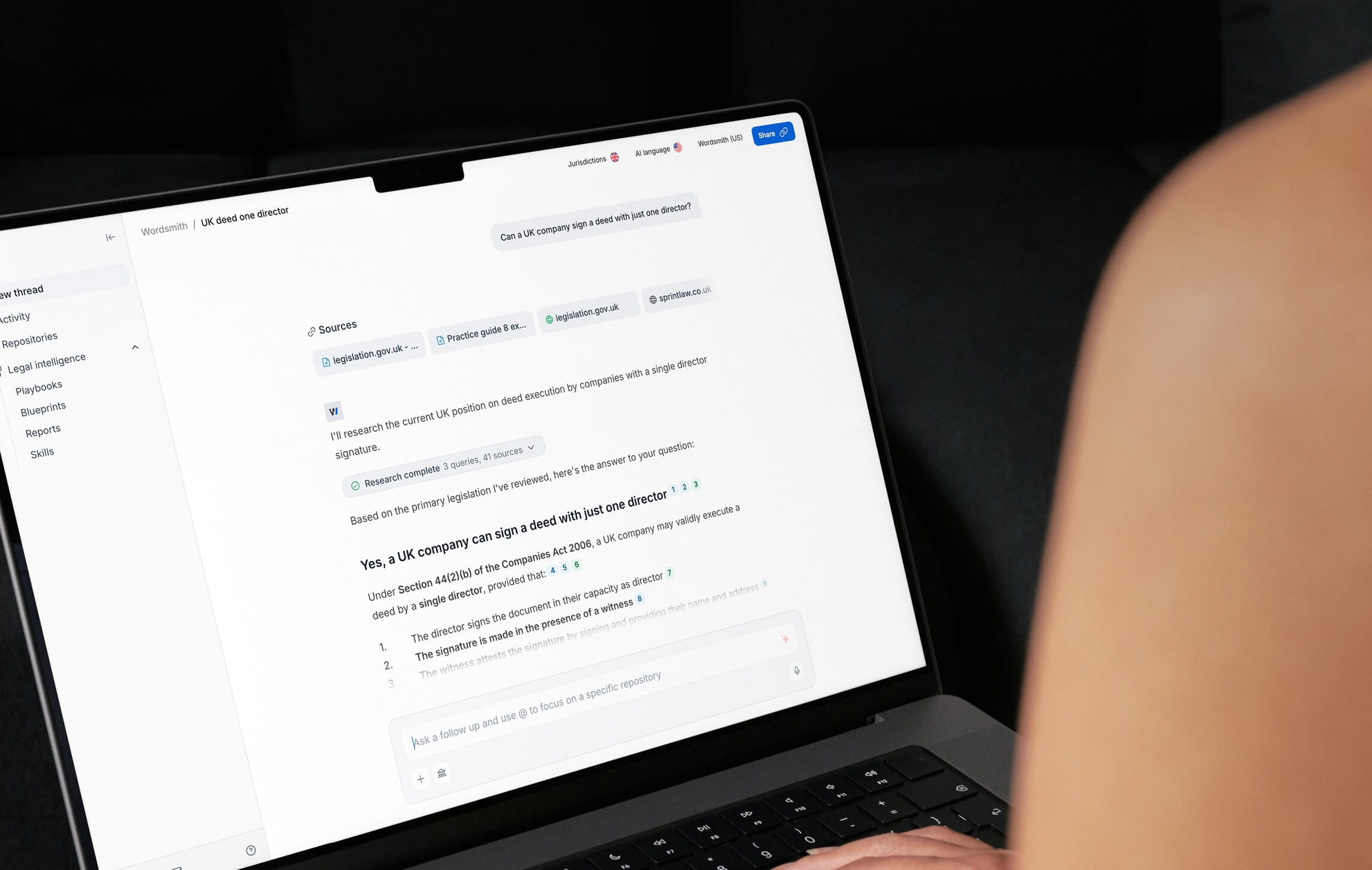
For example, an AI-native platform like Wordsmith can automate 95% of NDAs based on your company’s playbook. The 5% that deviate from policy are escalated to a human lawyer. This is how experienced in-house teams already think about risk. AI simply makes that model viable at scale.
So, Will AI Replace In-House Lawyers?
No. But it will replace:
Unnecessary manual review
Slow feedback loops
Legal teams drowning in low-value work
It will reward lawyers who understand context, can communicate clearly with machines, and can exercise judgment under uncertainty. And it will expose lawyers who rely on repetition instead of reasoning.
The question is not, “Will AI replace lawyers?” The better question is, “What kind of lawyer will still be valuable in an AI-augmented world?”
The answer is clear. The lawyer who understands ambiguity, incentives, risk, and people is not going anywhere. They are finally getting better tools.
Frequently Asked Questions (FAQ)
Q1: What legal tasks are most likely to be automated by AI?
High-volume, repetitive tasks like first-pass document review, data extraction, generating standard agreements, and summarizing transcripts are most likely to be automated. This frees up lawyers to focus on strategy, negotiation, and complex analysis.
Q2: How does AI adoption differ between law firms and in-house legal teams?
In-house teams are generally adopting AI faster because they are cost centers measured on efficiency and speed. Law firms, which traditionally bill by the hour, face a conflict between AI-driven efficiency and their revenue model, slowing adoption.
Q3: What is the most important skill for a lawyer in the age of AI?
Judgment. The ability to take the information and analysis provided by AI and make a strategic decision based on business context, risk tolerance, and human factors is the most valuable and irreplaceable skill.