.
Article
Build vs. Buy: The Definitive Guide to Choosing a Legal AI Platform in 2026
Should you build, buy, or use generic AI for legal work? Compare costs, risks, and benefits to make the right decision for your legal team in 2026.

Introduction: The In-House AI Dilemma
In today's fast-paced business environment, in-house legal teams are under unprecedented pressure to operate as strategic enablers rather than cost centers. The mandate is clear: move faster, show impact, and guide the business with confidence. The explosion of generative AI has presented what appears to be a silver bullet, promising to automate routine tasks, accelerate contract review, and provide instant answers to complex legal questions. However, this promise comes with a critical and often underestimated challenge: choosing the right implementation path.
For General Counsel and Legal Operations leaders, the AI dilemma presents a strategic fork in the road. Do you leverage internal engineering talent to build a custom solution tailored to your exact needs? Do you embrace the accessibility of generic, consumer-grade AI tools like ChatGPT and hope for the best? Or do you buy a purpose-built legal AI platform designed specifically for the security, accuracy, and workflow demands of an enterprise legal department? Each path carries its own set of benefits, risks, and, most importantly, hidden costs.
This guide is designed to provide a clear, comprehensive framework for navigating this decision. We will move beyond the surface-level hype to conduct a rigorous analysis of the build vs. buy dilemma, helping you make a strategic choice that aligns with your team's goals, budget, and risk tolerance. By understanding the true total cost of ownership, the nuanced security implications, and the long-term strategic value of each approach, you can confidently lead your organization into the future of legal work.
The Allure and Hidden Costs of Building Your Own Legal AI
The temptation to build a custom legal AI solution is understandable. It promises complete control, perfect alignment with unique internal workflows, and the potential to create a proprietary asset. However, what begins as an ambitious internal project often evolves into a costly, resource-intensive endeavor that distracts from core business objectives. A realistic assessment reveals that the true cost of building extends far beyond the initial lines of code.
The Perceived Benefits
Leaders are often drawn to the idea of a custom build for several compelling reasons. Total customization seems to offer a perfect fit, allowing the tool to be molded around existing processes without compromise. Intellectual property ownership is another significant draw, with the potential to create a unique competitive advantage. Finally, the idea of leveraging an existing in-house engineering team can make the project seem more cost-effective than purchasing a commercial license.
The Reality: A Deep Dive into the True Costs
While the benefits are appealing, they are often overshadowed by a wide range of direct and indirect costs that are not immediately apparent. A simple prototype might cost over $100,000 in engineering time alone, but the total cost of ownership for a production-ready, enterprise-grade system is substantially higher.
Engineering & Development: The most visible cost is the initial build, which can easily consume 6-12 months of a dedicated engineering team's time. In a competitive market for AI and machine learning talent, the salaries required to attract and retain these specialists represent a significant ongoing investment. During this lengthy development period, the legal team continues to operate without the benefit of AI automation, delaying any potential efficiency gains.
Data Acquisition & Training: An AI is only as good as the data it's trained on. Building an effective legal AI requires access to a massive, curated dataset of contracts, clauses, and other legal documents. Sourcing, cleaning, and structuring this data is a monumental task that requires specialized expertise in both law and data science. Generic models are trained on the open internet; a custom legal model requires high-quality, proprietary data that is difficult and expensive to acquire.
Ongoing Maintenance & Updates: The work does not end at launch. A custom-built tool requires continuous maintenance to fix bugs, address evolving security threats, and respond to feature requests from the legal team. AI models also suffer from "model drift," where their performance degrades over time as legal standards and business practices change, necessitating regular retraining and validation.
Security & Compliance Overhead: An AI tool that handles sensitive legal documents must meet the highest standards of security and compliance. Achieving and maintaining certifications like SOC 2 Type 2 and ISO 27001 is a complex and expensive process involving rigorous audits, documented controls, and continuous monitoring. A home-grown tool places this entire burden on the internal team.
Opportunity Cost: Perhaps the most significant hidden cost is the opportunity cost. Every hour your engineering team spends building and maintaining an internal legal tool is an hour they are not spending on your core, revenue-generating product. This diversion of resources can slow innovation and impact your company's competitive position in the market.
The Risks of Using Generic, Consumer-Grade AI for Legal Work
If building is too costly, the next logical consideration is often to use readily available, low-cost generic AI tools. While these platforms are remarkably capable at general text generation, they are fundamentally unsuited for the high-stakes environment of professional legal work. Using them for contract review, legal research, or compliance analysis introduces a level of risk that most legal departments would find unacceptable.
The Accuracy Problem: Hallucinations as a Feature, Not a Bug
Large Language Models (LLMs) work by predicting the next most probable word in a sequence, based on patterns learned from vast amounts of internet text. They do not possess a true understanding of facts, logic, or legal principles. This leads to a phenomenon known as "hallucination," where the AI confidently generates plausible-sounding but entirely fabricated information. In a legal context, this can manifest as citing non-existent case law, inventing contractual clauses with subtle but critical flaws, or misinterpreting complex regulatory requirements. For a legal professional, relying on such a tool is akin to accepting legal advice from an unverified source.
The Security Black Box: A Breach of Confidentiality Waiting to Happen
Most consumer-grade AI tools explicitly state in their terms of service that they may use submitted data to train their models. When an attorney uploads a confidential contract or asks a question about a sensitive legal matter, that information can be absorbed into the model, potentially becoming accessible to other users or being exposed in a data breach. This practice creates an unacceptable risk of waiving attorney-client privilege and violating duties of confidentiality. Furthermore, these tools often lack the robust audit trails necessary to demonstrate compliance or investigate an incident, operating as a "black box" from a security perspective.
The "One-Size-Fits-None" Issue
Legal work is highly contextual. A contract clause that is acceptable for one deal may be a major risk in another. Generic AI models lack the ability to understand this context. They cannot be trained on a company's specific legal playbooks, risk tolerances, or negotiation history. As a result, their output is generic by definition, failing to provide the tailored, nuanced guidance that in-house counsel are expected to deliver.
Comparison Table: Generic AI vs. Purpose-Built Legal AI
Feature | Generic AI (e.g., ChatGPT) | Purpose-Built Legal AI (e.g., Wordsmith) |
|---|---|---|
Primary Function | General text and content generation | Legal-specific tasks (contract review, drafting, analysis) |
Data Training | Broad, unfiltered internet data | Curated legal documents, statutes, and customer playbooks |
Accuracy | Variable, prone to factual and logical hallucinations | High, optimized for legal precision and grounded in sources |
Security | Often uses customer data for training; general security | SOC 2 Type 2 certified; Zero Data Retention policies |
Customization | Limited to user prompts and instructions | Deeply customizable with company-specific legal playbooks |
Audibility | Low, difficult to trace the AI's reasoning process | High, provides clear audit trails for compliance |
Workflow Integration | Minimal, typically requires copy-pasting | Deep integration with Word, email, and business platforms |
The Strategic Advantage of a Purpose-Built Legal AI Platform
Choosing to buy a purpose-built legal AI platform like Wordsmith allows legal teams to avoid the pitfalls of both building and using generic tools. These platforms are designed from the ground up to meet the specific needs of in-house legal departments, offering a powerful combination of advanced functionality, enterprise-grade security, and rapid time-to-value.
Day 1 Value: Unlike a custom build that can take a year or more to become useful, a purpose-built platform delivers value from day one. The models are already trained on vast legal datasets, and the core features for contract review, playbook creation, and workflow automation are ready to be deployed immediately.
Enterprise-Grade Security & Compliance: Leading legal AI platforms are built on a foundation of security. Wordsmith, for example, is SOC 2 Type 2 certified and offers a Zero Data Retention policy, ensuring that your confidential information is never stored or used for training. This level of security is non-negotiable for legal work and is extremely difficult and expensive to replicate in-house.
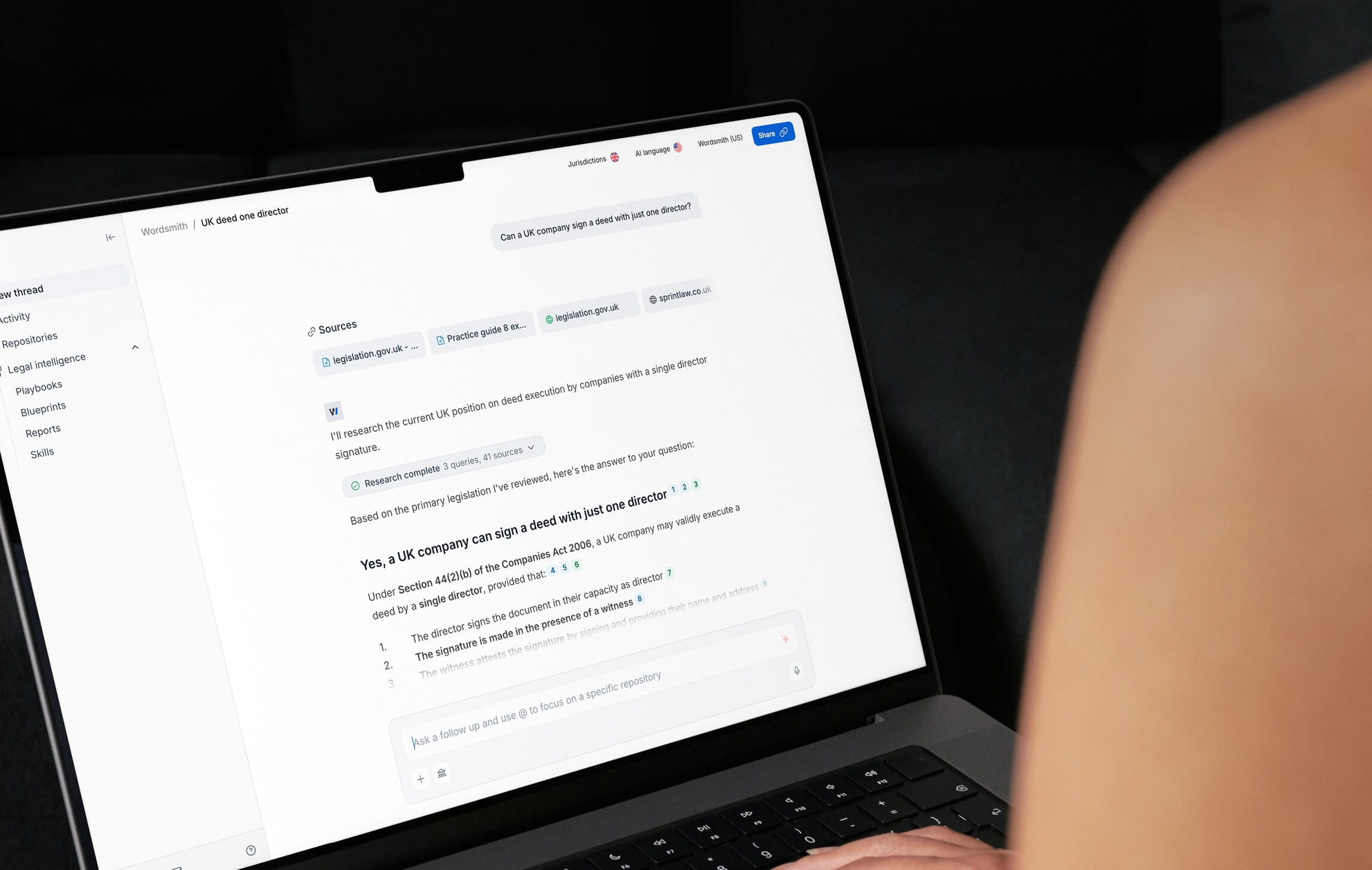
Deep Workflow Integration: Modern legal AI moves beyond a simple chat interface. It integrates directly into the tools where lawyers and business users already work, such as Microsoft Word, email, and Slack. This eliminates the need for context-switching and copy-pasting, seamlessly embedding AI assistance into the natural flow of work.
The Power of Legal Intelligence: Purpose-built platforms are more than just language models; they are legal intelligence engines. They understand the relationships between different clauses, recognize jurisdiction-specific nuances, and can apply a company's unique risk tolerance through customizable legal playbooks. This allows the AI to provide guidance that is not just accurate, but strategically aligned with the business.
Case Study: How a Tech Company Reduced Contract Review Time by 90%
To illustrate the impact of a purpose-built platform, consider the case of a rapidly scaling SaaS company. Their legal team of five was struggling to keep up with a high volume of sales agreements and vendor contracts, creating a significant bottleneck in the deal cycle.
The Challenge: The legal team was spending over 80% of its time on routine contract review, primarily for standard NDAs and Master Service Agreements. This left little time for strategic work and caused frustration among the sales team, who saw deals delayed by legal review queues. The General Counsel knew that hiring more attorneys was not a scalable solution.
The Solution: The company implemented Wordsmith's AI platform. Over a period of three weeks, the legal team worked with Wordsmith's legal engineers to codify their existing negotiation playbook into a series of automated AI Blueprints. They defined their standard positions, fallback options, and escalation triggers for key clauses like Limitation of Liability, Indemnification, and Data Privacy.
The Result: The impact was immediate and transformative. The AI was able to conduct a first-pass review of all incoming standard contracts, automatically redlining non-compliant clauses and suggesting pre-approved fallback language. Routine agreements were often approved in minutes rather than days. Within the first quarter, the company measured a 90% reduction in time spent on routine contract review. This freed up the legal team to focus on high-value negotiations and strategic projects, effectively transforming the department from a bottleneck into a business accelerator.
FAQ: Build vs. Buy for Legal AI
Is it cheaper to build our own AI tool in the long run?
While the initial subscription cost of a purpose-built platform may seem higher than the starting budget for an internal project, the total cost of ownership (TCO) analysis almost always favors buying. When you factor in the ongoing costs of engineering salaries, data acquisition, server maintenance, security compliance, and continuous model updates, a custom-built solution is significantly more expensive over a 3-5 year period. Buying provides predictable costs and includes all updates and maintenance in the subscription.
Can't we just fine-tune a generic LLM for our legal needs?
Fine-tuning a generic model on your own documents can slightly improve its performance on specific tasks, but it does not solve the fundamental architectural problems. Fine-tuning does not address the core security risks, the lack of audibility, or the inability to integrate deeply into legal workflows. It is a surface-level fix for a foundational issue. Purpose-built platforms use a combination of proprietary models, retrieval-augmented generation, and legal-specific guardrails that go far beyond simple fine-tuning.
What are the key security questions to ask a legal AI vendor?
Every legal team should have a standard security questionnaire for AI vendors. Key questions include: Do you have a SOC 2 Type 2 certification? Do you offer a Zero Data Retention policy? Where is my data processed and stored? Can you provide a dedicated, single-tenant instance? How do you prevent my confidential data from being used to train your models? What are your data breach notification procedures?
How long does it take to implement a purpose-built legal AI platform?
Implementation times can vary depending on the complexity of your legal playbooks and the number of workflows you wish to automate. However, a typical implementation for a mid-sized legal team takes between two and eight weeks. This includes initial setup, playbook configuration, user training, and integration with existing systems. This is a fraction of the time it would take to build a comparable tool from scratch.
Conclusion: Making the Right Decision for Your Legal Team
The decision of whether to build, use generic AI, or buy a purpose-built platform is one of the most critical strategic choices a modern legal leader will make. While the allure of a custom-built solution is strong and the convenience of generic AI is tempting, a clear-eyed analysis of cost, risk, and long-term value points to a decisive conclusion.
For the vast majority of in-house legal teams, investing in a purpose-built legal AI platform offers the most effective, secure, and cost-efficient path to leveraging the power of artificial intelligence. It allows you to stand on the shoulders of dedicated legal tech experts, benefiting from their deep investment in security, accuracy, and workflow engineering. This approach frees your legal team to focus on what it does best: providing strategic, high-judgment advice, while empowering the rest of the business to move faster with confidence.
To see how a purpose-built platform can transform your legal operations, we invite you to book a demo and experience the future of legal work firsthand.