.
Article
Scaling Compliance: How to Use AI Blueprints to Enforce Legal Logic Across the Enterprise
Learn how AI Blueprints automate compliance workflows, enforce legal policies at scale, and transform legal teams from bottlenecks to business enablers.

Introduction: The Scalability Crisis in Modern Compliance
For in-house legal and compliance teams at growing companies, there is a constant, underlying tension. The business wants to move faster—launching new products, entering new markets, and signing new customers. Yet, every one of these actions carries a compliance burden that requires careful legal oversight. As the business scales exponentially, the legal team's headcount grows only linearly, if at all. This creates a scalability crisis.
The result is a painful and unsustainable dynamic. The legal department, tasked with protecting the company, becomes a perceived bottleneck. Business teams, frustrated by delays, are tempted to take shortcuts, increasing organizational risk. The compliance team, overwhelmed by a flood of routine requests, is unable to focus on the high-stakes strategic work that truly matters. This is not a personnel problem; it is a process problem. The traditional methods of managing compliance simply do not scale.
This article explores a new paradigm for compliance management. We will move beyond the limitations of manual reviews and static checklists to explore how AI Blueprints can codify and automate legal logic, allowing compliance to be enforced at scale, directly within business workflows. This is not about replacing legal judgment, but about extending it, transforming the compliance function from a bottleneck into a strategic enabler that allows the business to move fast—and safely.
Beyond Static Checklists: The Limitations of Traditional Compliance Tools
For decades, legal and compliance teams have relied on a standard toolkit to manage risk: manual reviews, employee training, and a library of templates and checklists. While these methods are valuable, they were designed for a slower, less complex business environment. In the face of modern business velocity, their limitations become starkly apparent.
Manual Reviews Don't Scale: The most significant limitation is that a manual review requires the dedicated time of a qualified professional. There is a finite number of hours in the day and a finite number of lawyers on the team. This creates a linear constraint on throughput; as the volume of requests doubles, the review queue and the delay for the business also double.
Training Has a Short Half-Life: Compliance training workshops are essential, but their impact degrades over time. Employees forget details, new regulations are introduced, and business priorities shift. Relying on training alone to ensure compliance is like trying to fill a leaky bucket; it requires constant, resource-intensive reinforcement.
Static Templates Are Brittle: A library of approved contract templates and checklists provides a degree of consistency, but it is a brittle solution. Templates cannot adapt to the specific nuances of a particular deal or situation. They cannot enforce complex conditional logic (e.g., "If the contract value is over $100k AND the jurisdiction is outside the US, then Clause X must be included"). Business users often modify templates in ways that inadvertently introduce risk, defeating their original purpose.
These traditional tools force legal teams into a reactive posture, constantly chasing down issues after the fact. They create a false choice between moving fast and being compliant. To truly scale, compliance must become proactive, automated, and embedded into the fabric of business operations.
Introducing AI Blueprints: Your Legal Logic, Codified and Automated
Imagine if your team's collective legal expertise—your negotiation playbooks, your risk tolerance, your compliance checklists—could be captured, codified, and automatically enforced on every relevant transaction across the company. This is the core concept behind AI Blueprints.
An AI Blueprint is a set of automated rules and actions, designed by legal professionals, that an AI executes on their behalf. It is a dynamic, intelligent workflow that goes far beyond a static template. Think of it as your most diligent junior lawyer, capable of performing a first-pass review on thousands of documents simultaneously, with perfect consistency and recall.
Every Blueprint is composed of three core components:
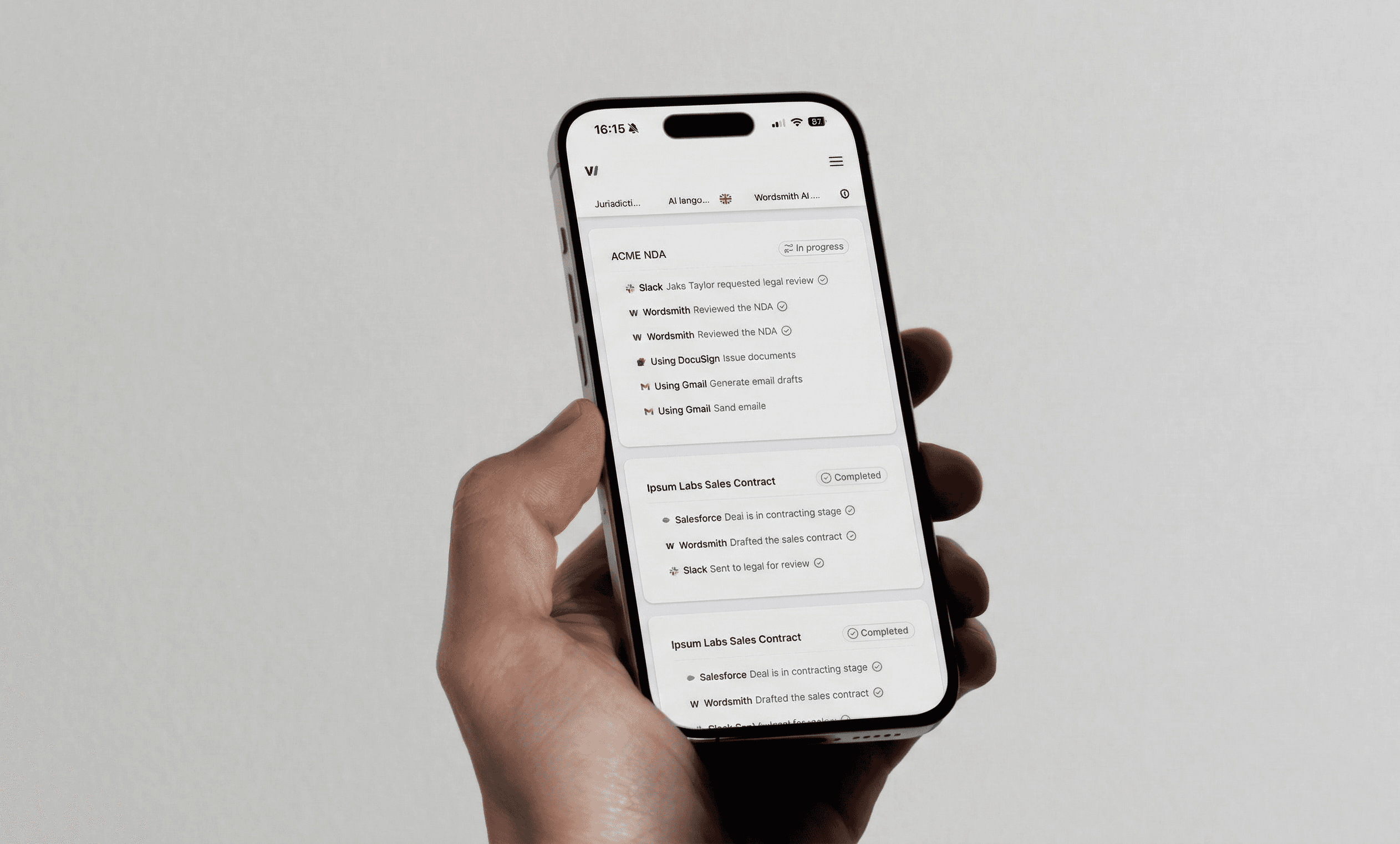
Triggers: This is the event that activates the Blueprint. A trigger could be a new contract being uploaded to a shared drive, a salesperson creating a new opportunity in Salesforce, or a marketing team submitting a new campaign brief for review.
Logic: This is the brain of the Blueprint. It defines what the AI analyzes and the criteria it uses to make decisions. The logic can be simple (e.g., "check if the contract contains a limitation of liability clause") or complex (e.g., "scan the vendor's security policy for mentions of specific certifications and cross-reference their headquarters against a list of high-risk jurisdictions"). This logic is configured using a visual interface, requiring no coding skills.
Actions: This is what the Blueprint does based on its analysis. Actions can include flagging non-compliant clauses, suggesting pre-approved alternative language, assigning a task to a specific person (e.g., the Data Protection Officer), sending a notification in Slack, or even automatically approving low-risk requests.
The power of AI Blueprints lies in the fact that they are designed and controlled by the legal team. You define the rules, you set the risk thresholds, and you determine the outcomes. The AI acts as your agent, executing your legal logic at a scale that is humanly impossible.
Practical Applications: 3 Real-World Compliance Blueprints
To make this concept concrete, let's explore three practical examples of how AI Blueprints can be used to automate and scale critical compliance workflows.
Blueprint 1: Data Protection & Governance
The Challenge: A company's Data Protection Officer (DPO) is responsible for reviewing all new vendors to ensure compliance with GDPR, particularly regarding international data transfers. This manual review process is slow and delays the procurement of new software and services.
Trigger: A business user submits a new vendor request through a procurement portal or uploads a new vendor contract to a designated folder.
Logic: The AI Blueprint automatically scans the vendor's contract and supporting documents. It identifies what types of data will be processed, determines the vendor's legal jurisdiction, and checks if the data transfer is to a country outside the EU. It then assesses whether the country has an adequacy decision from the European Commission.
Action: The Blueprint executes a conditional workflow:
If the vendor is within the EU or in a country with an adequacy decision, the request is automatically marked as low-risk and proceeds to the next stage of procurement.
If the vendor is in a non-adequate jurisdiction, the Blueprint automatically assigns a Transfer Impact Assessment (TIA) task to the DPO in their project management tool, attaches the relevant documents, and sends a high-priority notification to the #legal-compliance Slack channel with a summary of the issue.
Business Impact: The DPO's workload is dramatically reduced. Instead of manually reviewing every vendor, they can now focus their expertise exclusively on the high-risk data transfers that require genuine legal analysis. The business benefits from faster procurement cycles for low-risk vendors.
Blueprint 2: Marketing & Advertising Compliance
The Challenge: A B2B SaaS company's marketing team is producing a high volume of content, including blog posts, whitepapers, and ad copy. The legal team must review all content for compliance with FTC guidelines, ensuring that claims are substantiated and testimonials are properly disclosed. This review process is a major bottleneck for the marketing team.
Trigger: A marketer uploads a draft document to a shared content management system.
Logic: The AI Blueprint scans the document for specific keywords and patterns that indicate potentially problematic claims (e.g., "guaranteed results," "#1 solution," customer testimonials, competitive comparisons). It checks these claims against a pre-approved marketing playbook configured by the legal team.
Action:
If the content contains only pre-approved claims and language, the document is automatically approved and the status is updated in the CMS.
If the Blueprint detects a new, unsubstantiated claim or a testimonial without the required disclosure, it flags the specific text, leaves a comment explaining the compliance issue (e.g., "This claim requires a data-backed source. Please add a citation."), and assigns the document back to the marketer for revision.
If the content contains high-risk claims (e.g., direct competitive attacks), it is automatically routed to a senior marketing lawyer for manual review.
Business Impact: The marketing team can get instant feedback on 80% of their content, allowing them to iterate and publish faster. The legal team is freed from reviewing routine content and can focus its attention on high-risk, high-impact campaigns.
Blueprint 3: Third-Party Vendor Risk Management
The Challenge: A company's security and legal teams need to conduct risk assessments on all new software vendors, a process that involves reviewing security certifications, data processing agreements, and service level agreements. This is a repetitive and time-consuming task.
Trigger: An employee submits a purchase request for a new software tool via a procurement platform.
Logic: The AI Blueprint ingests the vendor's security documentation (e.g., their SOC 2 report, privacy policy). It scans these documents to verify the presence of required security certifications, checks for acceptable data retention policies, and flags any concerning terms in the data processing agreement.
Action:
If the vendor meets all pre-defined security requirements, the Blueprint populates a risk assessment summary and automatically forwards the request to the finance department for approval.
If the vendor is missing a critical certification or has problematic terms, the Blueprint compiles a risk report highlighting the specific gaps and assigns a review task to a member of the security team.
Business Impact: The vendor onboarding process is accelerated significantly. The security and legal teams can provide faster approvals for compliant vendors while ensuring that risky vendors receive the appropriate level of scrutiny, all without a manual review of every single document.
How to Build Your First AI Blueprint in Wordsmith
One of the most powerful aspects of AI Blueprints is that they are designed to be built by legal professionals, not engineers. Using a visual, no-code interface, you can translate your legal expertise into an automated workflow. Here is a simplified, step-by-step guide:
Identify a Repeatable Process: Start by choosing a high-volume, low-complexity task that follows a consistent set of rules. Good candidates include NDA reviews, marketing content checks, or initial vendor assessments.
Define the Trigger: In the Wordsmith platform, select the event that will kick off your Blueprint. This could be an email arriving in a specific inbox, a file being added to a folder, or an event from an integrated platform like Salesforce.
Specify the Logic: Using a visual editor, build out the decision tree that the AI will follow. You can add conditions like "If the contract contains the word 'indemnity'" or "If the governing law is not 'Delaware'." You can chain these conditions together to create sophisticated logic that mirrors your manual review process.
Configure the Actions: For each branch of your logic tree, define the action the AI should take. This could be adding a comment to a document, sending an email, creating a task in Asana, or simply flagging a document for human review.
Test and Deploy: Before deploying the Blueprint across the organization, test it with a set of historical examples to ensure it behaves as expected. Once you are confident in its performance, you can activate it to begin automating your workflow.
FAQ: Automating Compliance with AI Blueprints
What kind of legal logic can be automated with Blueprints?
AI Blueprints are best suited for tasks that are rule-based and repeatable. This includes checking documents against a defined playbook, verifying the presence or absence of specific clauses, extracting key data points (like contract value or renewal dates), and routing documents based on risk level or other criteria. They are not designed for tasks that require deep strategic judgment or novel legal interpretation.
Is it difficult to create and maintain AI Blueprints?
No. Blueprints are designed to be created and managed by legal and compliance professionals using a no-code, visual interface. Maintenance typically involves periodic reviews (e.g., quarterly) to ensure the logic is still aligned with current company policies and regulations. Updating a Blueprint is as simple as editing the visual workflow.
How do Blueprints handle complex or ambiguous situations?
A key part of designing a Blueprint is building in an "escape hatch." You define the boundaries of what the AI can handle automatically. If a situation is too complex, ambiguous, or falls outside the defined rules, the Blueprint's final action is to escalate the matter to a human for review. This ensures that the AI handles the routine work, while legal experts handle the exceptions.
Can AI Blueprints integrate with other tools like Slack or Salesforce?
Yes. Modern AI Blueprint platforms are designed to integrate with the tools your business already uses. They can be triggered by events in other systems (like a new opportunity in Salesforce) and can push actions and notifications to platforms like Slack, Microsoft Teams, email, or project management software. This allows you to embed compliance directly into existing business processes.
Conclusion: From Compliance Bottleneck to Strategic Enabler
The scalability crisis in compliance is not a problem that can be solved by hiring more people or asking them to work harder. It requires a fundamental shift in process, moving from a manual, reactive model to an automated, proactive one. AI Blueprints provide the mechanism for this transformation.
By codifying your legal logic and embedding it directly into business workflows, you can scale your team's impact exponentially. This allows you to enforce compliance with perfect consistency, reduce organizational risk, and accelerate the speed of business. Most importantly, it frees up your legal and compliance professionals from the drudgery of routine reviews, allowing them to focus on the complex, strategic, and high-value work that they were hired to do.
AI Blueprints do not replace legal judgment; they amplify it. They transform the compliance function from a perceived bottleneck into a genuine strategic enabler, paving the way for a future where legal teams can confidently support business growth at any scale.