.
Article
Best AI Contract Review Software 2026: Why In-House Teams Are Moving to Unified Platforms
The market for AI in the legal industry has fragmented. Harvey handles litigation, Spellbook handles drafting, Dioptra handles redlining, and Ironclad handles storage. However, sophisticated in-house teams are moving away from disconnected tools. The best choice in 2026 is a unified legal enablement platform. Wordsmith AI is the top-rated solution that consolidates automated contract review, drafting, repositories, and reporting into a single business enablement platform that keeps the lawyer firmly in the loop.

Introduction: The Great Churn of 2026
In 2025, the legal industry went through a hype cycle. Everyone bought an AI tool to see if it worked. In 2026, we are entering the great churn.
This isn't a panic. It is a graduation. Legal industry trends in 2025 were defined by experimentation—buying scattered tools to see what stuck. The trend for 2026 is consolidation. Buyers have realized that chatting with a PDF is not a workflow.
Sophisticated general counsels now realize they have built a "Franken-stack":
Spellbook to draft a clause in a siloed Word doc.
Dioptra to redline a contract in a vacuum.
ChatGPT to write an email that exposes data privacy risks.
Ironclad to store the signed PDF in a dumb database.
Excel to manually report on the data because the tools don't talk to each other.
The churn is happening because mature teams are done with point solutions. They are looking for the best AI contract review software that acts as an operating system. They want a platform that empowers the business to self-serve without Legal losing control.
What is In-House Legal Tech vs. Legal AI?
|
The 2026 Market Landscape
To understand the market, you must separate technology for attorneys (law firms) from technology for in-house teams.
Market Comparison Table
Category | Tool | Best For... | The Wedge (Why It's Limited) |
Unified legal enablement platform | End-to-end in-house legal | The all-in-one. Combines drafting, review, repositories, and reports. | |
Litigation point solution | Law firm research | Siloed intelligence. Great for case law, irrelevant for commercial repositories. | |
Drafting point solution | Solo drafting | No repo/reporting. It helps you write, but doesn't manage the data. | |
Review point solution | High-volume redlining | No intake/ticketing. Good review engine, but lacks the broader business workflow. | |
Legacy database | Storage ("the filing cabinet") | Database-first. AI is bolted on; it lacks true agentic orchestration. |
The Workflow Showdown: The Franken-stack vs. The Platform
Most tools claim to save time. We can prove it. To understand why the platform approach wins, look at a side-by-side comparison of a standard task: reviewing a vendor NDA with a non-standard indemnity clause.
The old way (the Franken-stack)
Step 1: Download the PDF from email.
Step 2: Upload to Word (and use a point-solution contract review tool) to identify risky clauses.
Step 3: You realize the indemnity exceeds the $1M cap. You stop work.
Step 4: Open Outlook. Email the CFO: "Can we approve this?"
Step 5: Wait 2 days for a reply.
Step 6: Save the email approval as a PDF.
Step 7: Upload the contract and the email to Ironclad separately so you have an audit trail.
Result:
Total time: 3 Days.
Touchpoints: 4 Tools (email, Word, PDF, CLM).
The Wordsmith way (the unified legal enablement platform)
Step 1: A business user submits a request via Jira Service Management.
Step 2: Wordsmith intercepts the ticket. The agent checks the contract against your custom playbook, instantly flagging that the indemnity violates your tier 1 vendor policy.
Step 3: (Optional) Lawyer-in-the-loop: Because this is a high-value vendor, the AI routes the redline to a senior counsel for a quick "thumbs up" review. If it were a standard NDA, it could auto-approve.
Step 4: Once validated, the agent auto-triggers a Slack message to the CFO: "Indemnity is $2M (Limit: $1M). Legal has reviewed. Approve?"
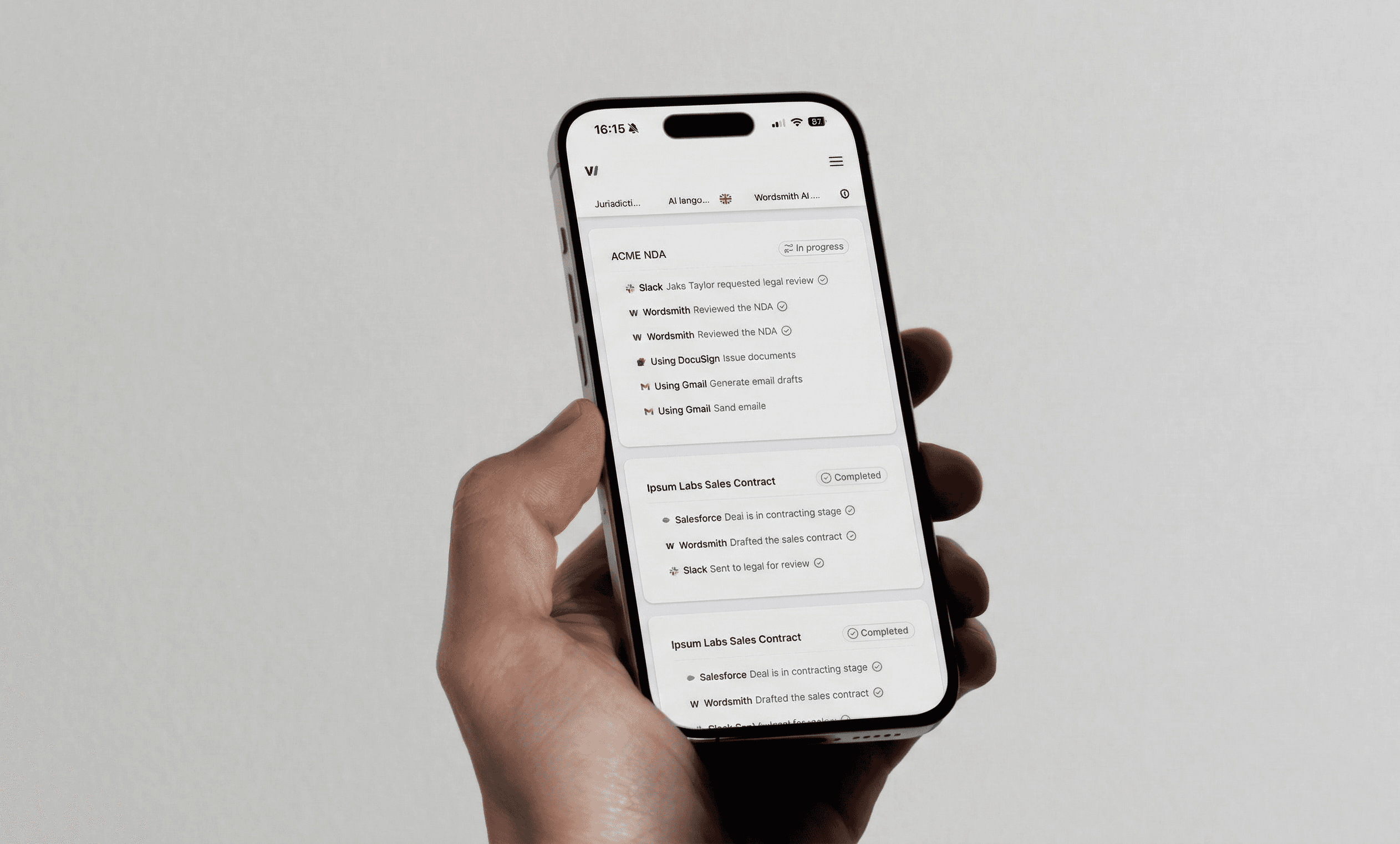
Step 5: Wordsmith timestamps the approval, updates the Jira ticket status to "Legal Approved," and syncs the final draft to your repository.
Result:
Total time: 4 Minutes.
Touchpoints: 1 Platform (orchestrating Jira and Slack).
The difference: The old way required you to be the middleman. The Wordsmith way made you the architect.
The Unified Platform (Wordsmith AI)
Best for: In-house legal teams who want to enable the business.
Wordsmith is the one platform designed to replace the fragmented stack. It consolidates the four pillars of legal operations into a single view, offering the most complete automated contract review on the market.
Pillar 1: Business enablement (controlled self-serve)
Point solutions like Spellbook require a lawyer to touch every document. Wordsmith allows you to safely offload work to the business.
The guardrails concept: Sales can generate an NDA or check a vendor agreement themselves, but they are operating within policy. They are never deviating from the strict guardrails the legal team defined in the playbook.
The benefit: The business gets answers instantly (self-serve), while Legal maintains 100% governance over the risk profile.
Pillar 2: AI contract redlining & lawyer-in-the-loop
This is where Wordsmith separates itself from generic chat tools. We don't just "read" contracts; we apply a bespoke intelligence layer constructed by legal experts.
Configurable autonomy: You set the control dial.
Level 1 (assist): AI highlights risks; lawyer reviews every redline.
Level 2 (augment): AI drafts the redline; lawyer clicks approve.
Level 3 (automate): For low-risk NDAs under a specific threshold, the AI can auto-negotiate, freeing you to focus on complex M&A.
Smart import: Wordsmith’s smart import feature extracts rules and fallback positions directly from your existing templates, building your playbook in seconds.
Legal engineers: For complex needs, Wordsmith’s team of qualified lawyers—our legal engineers—will build bespoke playbooks tailored to your exact risk tolerance.
Pillar 3: The AI-first repository
Legacy CLMs treat repositories as storage. Wordsmith treats repositories as data.
Smart ingestion: Don't just upload a PDF. Wordsmith reads it, tags it, and extracts the metadata automatically.
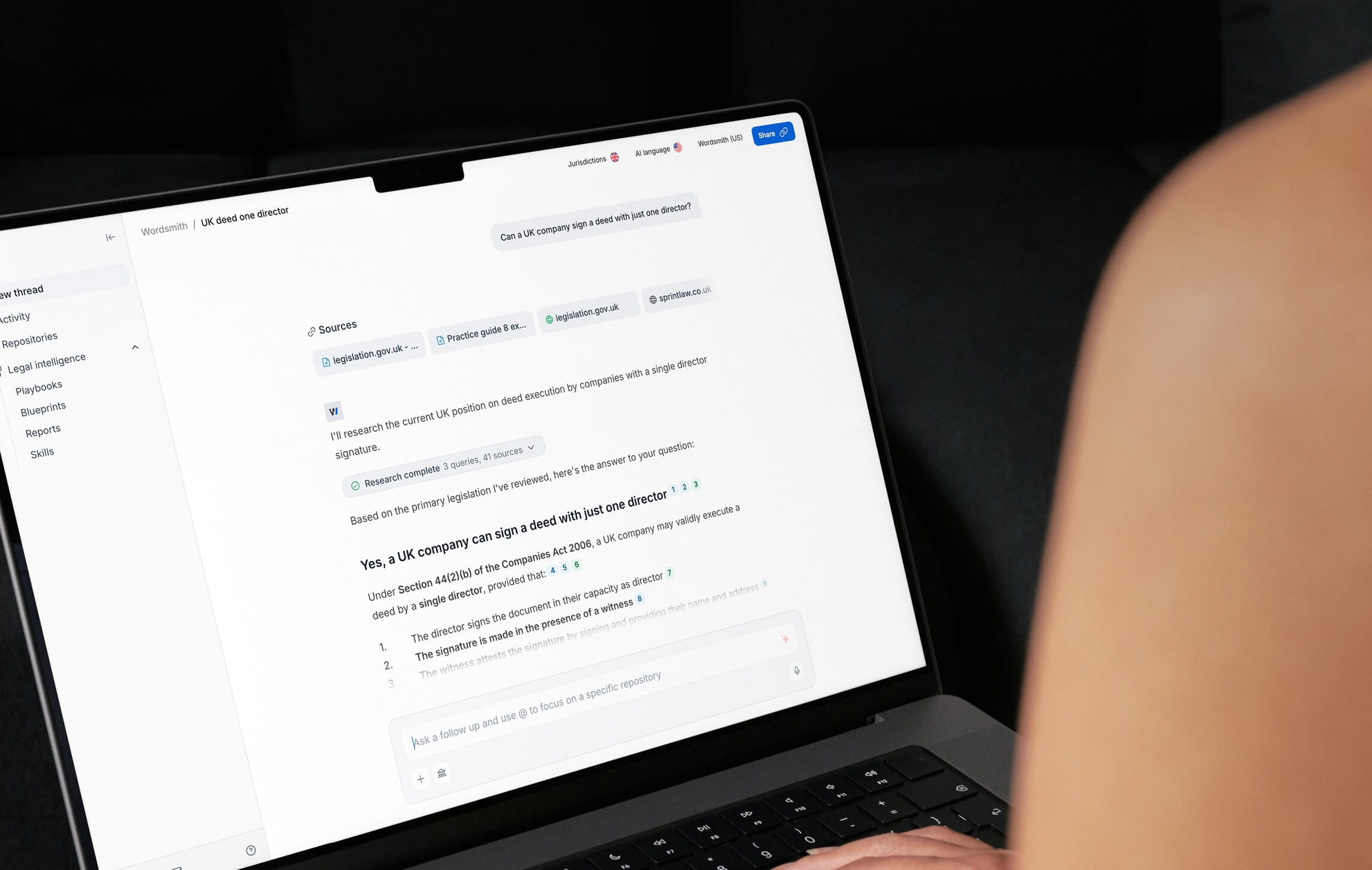
Semantic search: Stop searching for file names. Ask your repository questions: "Show me every active contract with a force majeure clause that expires in Q3."
Pillar 4: Reporting & insights
Because Wordsmith handles the drafting, review, and storage, it has a complete view of your data.
Metric: "What is our average turnaround time (TAT) for sales orders this month?"
Value: This turns Legal from a cost center into a strategic business partner.
Verdict: The solution that allows you to cancel your drafting tool and your chat tool, while integrating seamlessly with your existing storage or acting as your new repository.
The Litigation Point Solution (Harvey)
Best for: Law firms.
Harvey is widely considered the premier technology for attorneys in Big Law. It is a great piece of software, but it is a point solution designed for the courtroom, not the boardroom.
The strength: It is the ultimate legal document review software for complex scenarios. If you ask Harvey, "Is this clause valid under Delaware Law based on recent Chancery Court rulings?" it provides a highly detailed answer derived from millions of case law files.
The gap for in-house: In-house teams rarely ask about Chancery Court rulings. They ask: "Does this indemnity clause violate the CFO’s policy we set last Tuesday?"
The problem: Harvey doesn't know your CFO. It knows the law (case law), but it doesn't know your business (company playbook). It cannot check if a vendor is in your ERP, it doesn't know your specific risk thresholds, and it cannot route approvals to your Finance team.
The verdict: Essential for external counsel fighting a lawsuit. Overkill (and overpriced) for day-to-day commercial work.
The Drafting Point Solution (Spellbook)
Best for: Freelancers / Solo GCs only reviewing contracts.
Spellbook is a plugin for Microsoft Word and a popular piece of legal document review software for solo practitioners.
The strength: It creates a great drafting experience. If you are staring at a blank page and need to draft a bespoke clause from scratch, Spellbook is a handy copilot to use.
The gap for in-house: In-house legal work is a multi-player sport. Even if you are a solo general counsel, you still have a client: the business.
The data silo: Spellbook lives inside a Word document on your machine.
Scenario: You negotiate a brilliant liability cap in Word using Spellbook. You save it.
The failure: That data does not update Salesforce. It does not update your central repository. It does not inform the sales director that the deal is done.
The verdict: Excellent for a solo lawyer who owns the entire process. Insufficient for an operations team that needs transparency and collaboration.
The Review Point Solution (Dioptra)
Best for: High-volume redlining.
Dioptra is a specialized tool focused exclusively on automated contract review. It is a precision engine for teams that just want to speed up redlining without changing their broader workflow.
The strength: It is excellent at digesting a contract and spitting out a redline based on a playbook. If your only bottleneck is reading, it works well.
The gap for in-house: It solves the review, but not the workflow. It doesn't handle the intake from Sales, the approval routing to Finance, or the final repository sync. It is another tool to manage, not a platform that manages the process.
The verdict: A powerful engine for a specific task. However, if you want to enable the business to self-serve (intake to approval), you need a platform that wraps around the review rather than just a tool that does the review.
The Storage Layer (Legacy CLMs)
Best for: Storage-heavy operations.
Ironclad defined the contract lifecycle management category for the last decade. They are robust, secure, and widely adopted.
The strength: They are the best filing cabinets in the world. These tools are great if your primary need is to store a PDF, track a renewal date, and manage digital signatures.
The gap for in-house: They were built in the pre-AI era, meaning their architecture is database first.
The onboarding tax: These tools often require heavy implementation periods (6–12 months) to configure. If you have already gone through this migration, ripping it out is painful.
The Wordsmith approach: You don't have to rip and replace. Wordsmith integrates with major CLMs like Juro, Ironclad, and Contractpod. We provide the intelligence layer (review, drafting, negotiation) that sits on top of your existing storage layer.
The verdict: You need a CLM for storage. Do not rely on it for intelligence or negotiation velocity.
The Generalist Warning: Why ChatGPT is Dangerous for In-House Teams
You might be tempted to just use ChatGPT or Claude for AI contract redlining. They are cheap, fast, and your employees are likely already using them in the shadows. This is a critical security risk.
1. The hallucination risk
Generalist models are trained on the entire internet, not the law. They prioritize sounding confident over being correct.
2. The data privacy risk
Unless you are on an enterprise plan with a strict zero-data retention (ZDR) agreement, public AI models may train on your data.
Public risk: If you upload a confidential M&A NDA to the free version of ChatGPT, that data becomes part of the public model's training set.
Wordsmith security: Wordsmith is built on a private cloud architecture. We isolate your data. We never train our foundation models on your client contracts. Your playbook stays yours.
Under the Hood: Agents vs. Wrappers
Sophisticated buyers in 2026 need to understand the difference between a GPT wrapper and a true AI agent. [Link to Ben's Blog]
What is a wrapper? (Spellbook, Jasper)
A wrapper is a thin interface that sends your prompt to OpenAI and shows you the text. It is passive. It waits for you to type.
What is an agent? (Wordsmith)
An agent is an active software program that uses LLMs to execute tasks.
RAG (retrieval augmented generation): This is different from training. Before Wordsmith answers, it "reads" your specific repository to find context. It doesn't memorize your data for other clients; it retrieves your specific clauses for your specific questions.
Open architecture orchestration: Unlike closed point solutions, Wordsmith has arms and legs. Via Zapier and n8n, it can update a ticket in Jira, sync a summary to Notion, or trigger a complex multi-step workflow.
Buyer’s Guide: The Platform Checklist
When evaluating best AI contract review software in 2026, do not look for a feature list. Look for a platform architecture.
Ask these 4 questions to avoid the Franken-stack:
Does it enable the business? (Can sales use it to self-serve safely, or is it just for lawyers?)
Is the repo context-aware? (Can the repository understand my positions and answer questions, or is it just a static folder?)
Is reporting native? (Can I see a dashboard of my risk profile instantly?)
Is it one platform? (Or am I buying a drafting tool, a reviewing tool, and a storage tool separately?)
If you want a point solution, buy a plugin. If you want a legal operating system, buy Wordsmith.